Japanese for Elder Care: Kaigo Vocabulary, Grammar, and Conversation
On this page
- What the exam asks, what the floor says
- Vocabulary by time of day at the facility
- Paperwork, people, and workplace
- Early morning: changing clothes, toileting, oral care
- Meal and drink time
- Bathing, mobility, and fall prevention
- Evening and night: memory and mood
- Five sentence patterns from the exam to the night shift
- 1. 〜ましょうか: offering before you help
- 2. 〜てください, お〜ください, and 〜ていただけますか
- 3. 〜ますね and 〜ますよ: announcing each action
- 4. 〜ようです and 〜そうです: reporting what you observe
- 5. 介護記録 style: telegraphic sentences, 〜あり and 〜なし
- Three read-aloud situations: handover, bath time, call from family
- Morning shift handover
- Bath time at the day center
- Call from family
- Exam prep and listening practice for people who work and study
- Quick questions, short answers
- What does the caregiving specified-skills exam include?
- I already have N4, what Japanese is still hard at the facility?
- How do EPA and specified skilled labor differ for Japanese?
- How are 介護士 and 看護師 different?
- What do you call elderly people?
- The first thing to do tonight
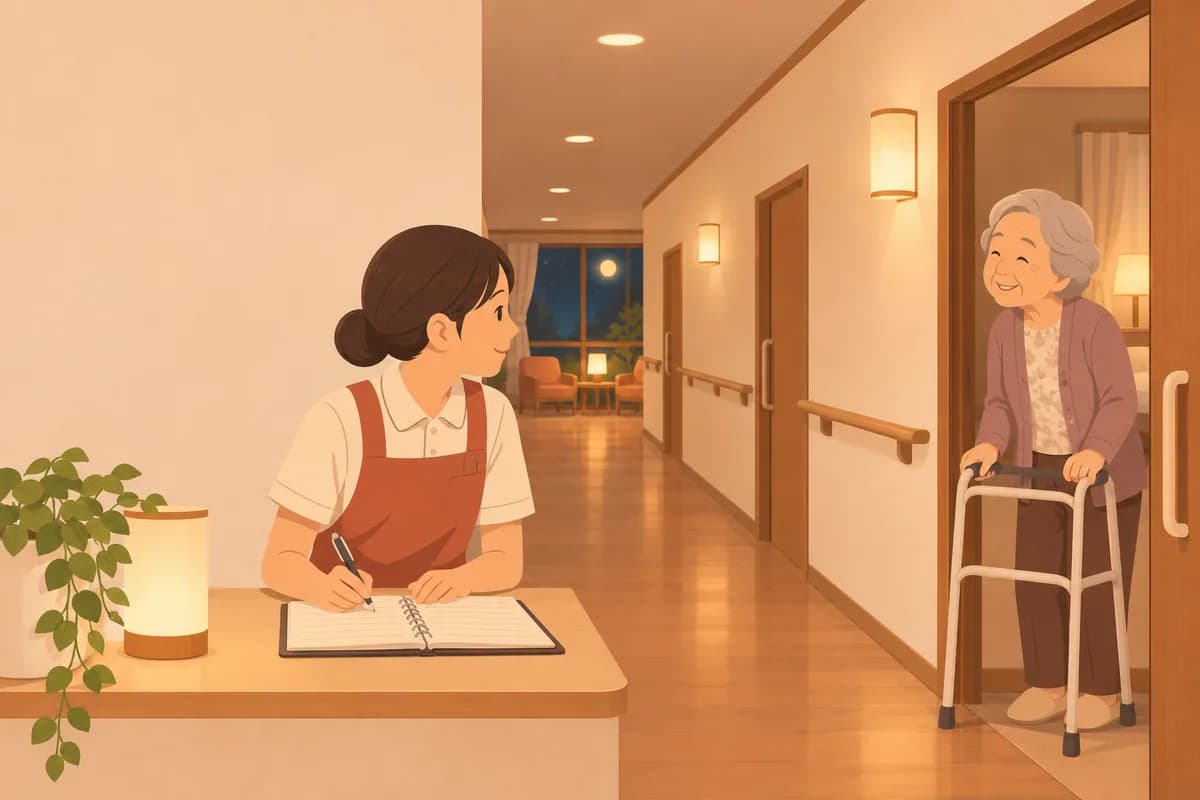
On your first night shift at a small group care home, the whole floor is just you and one Japanese colleague. On the table is the 申し送りノート; the afternoon-shift worker left three handwritten lines, and at 2 a.m. an elderly woman steps into the hallway and asks you something in a local accent. The bell to call the on-duty 看護師 is right beside you, and you have to decide what to say to whoever picks up.
That is what the caregiving (介護) specified-skills exam is measuring, even though the test paper looks like nothing but multiple-choice questions with furigana. The exam asks whether you understand 食事介助 and 入浴; the floor asks whether you can say 「お風呂に入りましょうか」 to someone who does not want to bathe. Both need the same vocabulary, but they use two very different kinds of Japanese.
This article is for people preparing for the skills exam and JLPT N4 to go to Japan as 介護職員, or studying in an EPA program. Vocabulary is grouped by time of day at the facility, with readings and example sentences plus translations. After that come five sentence patterns, three situations to read aloud, and a study plan. After the study section, you will have a word set you can play with right away.
- What the exam asks, what the floor says
- Vocabulary by time of day at the facility
- Five sentence patterns from the exam to the night shift
- Three read-aloud situations: handover, bath time, call from family
- Exam prep and listening practice for people who work and study
- Quick questions, short answers
- The first thing to do tonight
What the exam asks, what the floor says
The path to Japan for 介護 under specified skilled labor usually goes through three things: a vocational skills test, a separate Japanese test for caregiving, and proof of basic Japanese at N4 or equivalent. Conditions change by year and by program, so read the current rules from the organization sending you, even if this article says something different.
| You must read or hear | Form of Japanese | What to do |
|---|---|---|
| Skills exam and caregiving Japanese exam | Questions on care methods, with furigana, field terms like 誤嚥 and 褥瘡 | Learn field terms together with real situations |
| Speech to service users | です・ます, 〜さん, announce each step in advance | Copy model sentences, keep your voice slow and clear |
| Handover and coworkers’ speech | Fast, often drops subjects, many shortened words | Practice listening dictation sentence by sentence |
| 介護記録 | Telegraphic sentences, ending in nouns, lots of 〜あり and 〜なし | Practice reading first, writing later |
For many learners, the hardest part is the gap between two kinds of Japanese: the exam uses standard Japanese, while the floor has elderly people’s dialects, quiet voices, and unfinished sentences. Learning by situation helps you meet both. If you go the EPA route, the end goal is the national 介護福祉士 certificate, with a written exam in Japanese, so field vocabulary is needed early.
Vocabulary by time of day at the facility
The five tables below follow one day in order: paperwork and workplace, morning, meals, bathing and mobility, then evening and night. Each word has a kana reading. One point about how you speak: when writing records or talking to coworkers you use field terms like 更衣 and 排泄介助; with service users you use everyday words like お着替え and お手洗い.
Paperwork, people, and workplace
| Word | Reading | Meaning | Example sentence | Translation |
|---|---|---|---|---|
| 利用者 | りようしゃ | service user | 利用者の山本さんは、毎週火曜日にデイサービスに来ます。 | Mr. Yamamoto, a service user, comes to the day center every Tuesday. |
| 介護職員 | かいごしょくいん | care worker | 介護職員は、夜勤の日は午後4時に出勤します。 | Care workers on the night shift clock in at 4 p.m. |
| 介護施設 | かいごしせつ | care facility | この介護施設には、1フロアに20人の入居者がいます。 | This care facility has 20 residents on each floor. |
| 訪問介護 | ほうもんかいご | home care | 訪問介護の日は、朝9時に最初のお宅へ伺います。 | On home-care days, I visit the first client’s home at 9 a.m. |
| デイサービス | デイサービス | day care center | デイサービスの送迎車は、8時30分に出発します。 | The day center shuttle leaves at 8:30. |
| ケアプラン | ケアプラン | care plan | ケアプランが変わったので、リーダーから説明があります。 | The care plan changed, so the team leader will explain. |
| 介護記録 | かいごきろく | care record | 介護記録は、ケアのあとすぐに書きます。 | Care records are written right after care. |
| ケアマネジャー | ケアマネジャー | care manager, service planner | ケアマネジャーは、月に1回お宅を訪問します。 | The care manager visits the home once a month. |
The two characters 利用者 and 入居者 get mixed up easily. 入居者 means someone living in the facility; 利用者 is broader and includes people who come to day centers or receive home care. On the exam you will see 利用者 more often.
Early morning: changing clothes, toileting, oral care
| Word | Reading | Meaning | Example sentence | Translation |
|---|---|---|---|---|
| 更衣 | こうい | changing clothes | 更衣のときは、麻痺のある側から着てもらいます。 | When changing clothes, I have them dress the paralyzed side first. |
| 排泄介助 | はいせつかいじょ | toileting assistance | 排泄介助のあとは、必ず手を洗います。 | After toileting assistance, I always wash my hands. |
| 紙おむつ | かみおむつ | disposable diaper | 田中さんは、MサイズかLサイズの紙おむつを使っています。 | Mr. Tanaka uses size M or L disposable diapers. |
| おむつを替える | おむつをかえる | change a diaper | おむつを替えますね。少し横を向いてもらえますか。 | I’ll change your diaper. Could you turn a little to the side? |
| シーツ | シーツ | bed sheet | シーツを替えるときは、体を右に向けてもらいます。 | When changing sheets, I have them turn to the right. |
| 口腔ケア | こうくうケア | oral care | 食後は口腔ケアをして、うがいをしてもらいます。 | After meals I do oral care and have them rinse their mouth. |
| 入れ歯 | いれば | dentures | 入れ歯は、夜は外して洗います。 | At night dentures are removed and cleaned. |
| プライバシー | プライバシー | privacy | プライバシーを守るために、カーテンを閉めます。 | To protect privacy, I close the curtain. |
What is interesting about this word group is that professional rules sit right in the sentences: when dressing, start from the weak side; when undressing, start from the strong side. The exam often asks exactly this way, so read for meaning, not just characters. When speaking to a resident, do not say 「更衣をします」; say 「お着替えを手伝いますね」.
Meal and drink time
| Word | Reading | Meaning | Example sentence | Translation |
|---|---|---|---|---|
| 食事介助 | しょくじかいじょ | meal assistance | 食事介助は、一口ずつ飲み込むのを確認してから次をお出しします。 | With meal assistance, I wait until each bite is swallowed before offering the next. |
| ミキサー食 | ミキサーしょく | pureed food | ミキサー食は、ペースト状で飲み込みやすい食事です。 | Pureed food is a paste-like meal that is easy to swallow. |
| 嚥下障害 | えんげしょうがい | swallowing difficulty | 嚥下障害のある方の飲み物には、とろみをつけます。 | Drinks for people with swallowing difficulty are thickened. |
| 誤嚥 | ごえん | aspiration, food entering the airway | 誤嚥の疑いがあるときは、すぐに看護師に連絡します。 | When aspiration is suspected, I contact the nurse immediately. |
| 水分補給 | すいぶんほきゅう | hydration | 午前と午後に、お茶で水分補給をしてもらいます。 | Morning and afternoon I have them drink tea for hydration. |
| 食欲不振 | しょくよくふしん | loss of appetite | 3日前から食欲不振が続いているので、リーダーに伝えました。 | Appetite has been poor for three days, so I told the team leader. |
| とろみ | とろみ | thickener, thickness | お茶にとろみをつけますね。 | I’ll thicken your tea. |
誤嚥 shows up mainly in reports and on the exam. With a resident you only ask 「むせましたか」. When you hear coughing while eating, the first step is to stop the meal and report, not wait and see.
Bathing, mobility, and fall prevention
| Word | Reading | Meaning | Example sentence | Translation |
|---|---|---|---|---|
| 入浴 | にゅうよく | bathing | 入浴は週に2回で、火曜日と金曜日です。 | Bathing is twice a week, on Tuesday and Friday. |
| 清拭 | せいしき | bed bath / wiping the body | 熱があるときは入浴をやめて、清拭にします。 | When they have a fever, skip bathing and do a bed bath instead. |
| 移乗 | いじょう | transfer (bed to wheelchair or chair) | ベッドから車椅子への移乗は、リフトを使って行います。 | Transfer from bed to wheelchair is done with a lift. |
| 車椅子 | くるまいす | wheelchair | 車椅子のブレーキをかけてから、立ってもらいます。 | I set the wheelchair brake before helping them stand. |
| 歩行器 | ほこうき | walker | 歩行器を使えば、トイレまで歩けます。 | With a walker they can walk to the toilet. |
| リフト | リフト | patient lift | リフトを使うときは、スリングの位置を確認します。 | When using the lift, I check sling placement. |
| ベッド柵 | ベッドさく | bed rail | ベッド柵を使うかどうかは、家族と相談して決めます。 | Whether to use bed rails is decided after consulting the family. |
| 褥瘡 | じょくそう | pressure ulcer | 仙骨のあたりに褥瘡ができかけているので、看護師に報告します。 | There are early signs of a pressure ulcer near the sacrum, so I report to the nurse. |
| 転倒 | てんとう | fall | 転倒があったときは、すぐに記録して報告します。 | When there is a fall, I record and report immediately. |
| 機能訓練 | きのうくんれん | functional training | 機能訓練は、午後2時から15分間です。 | Functional training runs from 2 p.m. for 15 minutes. |
褥瘡 is how it is written in records; with residents and family you hear 床ずれ (とこずれ) more often. Both mean the same thing. On ベッド柵: in Japan bed rails can be seen as restricting a user’s freedom, so facilities usually ask the family and document the reason. You do not decide this on your own.
Evening and night: memory and mood
| Word | Reading | Meaning | Example sentence | Translation |
|---|---|---|---|---|
| 認知症 | にんちしょう | dementia | 認知症の方には、短い言葉でゆっくり話しかけます。 | With people who have dementia, I speak slowly in short sentences. |
| 物忘れ | ものわすれ | forgetfulness, memory decline | 最近、物忘れが増えたと、娘さんから聞きました。 | I heard from her daughter that she has been forgetting more lately. |
| 徘徊 | はいかい | wandering | 夕方に徘徊が見られるので、玄関のドアを見ておきます。 | She tends to wander in the evening, so I watch the entrance door. |
| 不穏 | ふおん | restlessness, agitation | 夕方に不穏になる方には、静かな音楽を流します。 | For people who get restless in the evening, I play quiet music. |
| 虚弱 | きょじゃく | frailty | 虚弱な方は、立ち上がるのに時間がかかります。 | Frail people need more time to stand up. |
| 自立 | じりつ | independence, doing things oneself | 自分でできることは、自立のために本人にしてもらいます。 | What they can do themselves, they do, to preserve independence. |
| 日常生活動作 | にちじょうせいかつどうさ | activities of daily living (ADL) | 入浴や着替えなど、日常生活動作の状態を毎月確認します。 | Each month I check ADL status for bathing, dressing, and the like. |
| レクリエーション | レクリエーション | recreation activities | レクリエーションは、体操と歌が人気です。 | At recreation, exercise and singing are popular. |
| 補聴器 | ほちょうき | hearing aid | 補聴器の電池が切れていないか、朝に確認します。 | In the morning I check whether the hearing-aid batteries are dead. |
| 安心させる | あんしんさせる | reassure | 手を握って声をかけ、安心させます。 | I hold their hand, speak to them, and reassure them. |
| 介助する | かいじょする | assist, help physically | 立ち上がるとき、後ろから軽く介助します。 | When they stand, I give light assistance from behind. |
On 徘徊: it is still the standard term on exams and in records, but many facilities now say ひとり歩き to avoid a negative tone, because people who walk around often have their own purpose, like looking for home or going to work. You should know both. In care, 自立 means letting residents keep doing what they still can.
Five sentence patterns from the exam to the night shift
1. 〜ましょうか: offering before you help
Drop ます from the verb, add ましょうか, used when you offer to help or invite someone to do something together. This is softer than a direct question, and older people usually accept it more easily.
- お手伝いしましょうか。
- お手洗いに行きましょうか。
- 少し休みませんか。
A common mistake among Vietnamese learners: asking straight out 「トイレに行きますか」 or calling the person あなた. In caregiving, 〜さん replaces あなた, and 〜ましょうか replaces a blunt question.
2. 〜てください, お〜ください, and 〜ていただけますか
〜てください is for simple step-by-step instructions. お〜ください (おかけください, お待ちください) is one notch more polite; 〜ていただけますか is when you ask for something that takes effort or you are not sure they will agree.
- こちらにおかけください。
- 腕を上げていただけますか。
- ゆっくり立ち上がってください。
Learners often use bare て forms (座って, 立って) because ください feels long, or mix in 〜なさい. With older people both sound like scolding a child. Keep ください for instructions and ていただけますか for requests.
3. 〜ますね and 〜ますよ: announcing each action
Care workers usually speak before touching someone. 〜ますね both notifies and lightly asks permission; 〜ますよ is when the action is about to happen right away, like standing or turning. This kind of announcement is called 声かけ and is part of the job.
- お体を拭きますね。
- 立ち上がりますよ。せーの。
- おむつを替えますね。
Two common mistakes. One is staying silent to save time, which startles the resident. Two is a childish tone, using 〜ちゃん or dragging out sentence endings. In a care facility that is seen as disrespectful even if the speaker means well. Use surname plus さん and speak adult to adult.
4. 〜ようです and 〜そうです: reporting what you observe
When you see or hear a sign but are not sure, use 〜ようです (seems to be, based on observation) or 〜そうです (looks like it is about to). These sentences help whoever reads the report know what is fact and what is your judgment.
- 今日は食欲がないようです。
- 少し熱がありそうです。
- 昨夜はあまり眠れなかったようです。
Learners’ mistake is saying straight out 「熱があります」 when they have only felt a warm forehead, not taken a reading. Judgments without numbers go with 〜ようです; numbers from a thermometer can be stated directly.
5. 介護記録 style: telegraphic sentences, 〜あり and 〜なし
Care records are not full sentences. People write events briefly, ending in nouns or 〜あり and 〜なし, with time and who was notified.
- 昼食 全量摂取。むせこみなし。
- 入浴実施。皮膚異常なし。
- 19時 居室で転倒あり。看護師に報告済み。
Common mistakes: writing long です・ます sentences, or feelings like 「かわいそうでした」. Records only note what was observed and what was done. The resident’s words are quoted verbatim in 「」.
Three read-aloud situations: handover, bath time, call from family
The three sections below are three kinds of people you will talk to: team leader, service user, and family. Nguyen is the learner. Read both roles aloud once, then cover the translation column and say Nguyen’s lines.
Morning shift handover
| Role | Japanese | Translation |
|---|---|---|
| Team leader Ito | おはようございます。申し送りを始めます。まず、1号室の山本さん。昨夜は2時に一度起きて、トイレに行きました。 | Good morning. I’ll start handover. First, Mr. Yamamoto in room 1. Last night he got up once at 2 a.m. to use the toilet. |
| Nguyen | トイレは、ご自分で行かれましたか。 | Did he go to the toilet on his own? |
| Team leader Ito | 歩行器を使って、見守りで行きました。今朝の体温は36.8度です。 | He used a walker; someone went with him to watch. This morning’s temperature is 36.8. |
| Nguyen | すみません、もう一度お願いします。体温は何度ですか。 | Sorry, could you say that again? What was the temperature? |
| Team leader Ito | 36.8度です。大丈夫ですよ。次に、3号室の小林さん。昨日の夕食は半分しか食べていません。 | 36.8. It’s fine. Next, Mr. Kobayashi in room 3. Yesterday he only ate half of dinner. |
| Nguyen | 食欲がないのでしょうか。 | Has he lost his appetite? |
| Team leader Ito | そのようです。今日の昼食も様子を見て、介護記録に書いてください。 | It seems so. Watch lunch today too and write it in the care record. |
| Nguyen | わかりました。水分補給は、どうしますか。 | Understood. What should we do about hydration? |
見守り in Ito’s words means standing close to observe without physically helping, a different level of support from 介助. Both terms appear in the ケアプラン and determine what you are allowed to do.
Bath time at the day center
| Role | Japanese | Translation |
|---|---|---|
| Nguyen | 高橋さん、こんにちは。お風呂の時間ですよ。お風呂に入りましょうか。 | Hello, Ms. Takahashi. It’s bath time. Shall we take a bath? |
| Ms. Takahashi | お風呂? 家で入ったわよ。 | A bath? I already bathed at home. |
| Nguyen | そうですか。今日は温かいお湯でゆっくりしませんか。体も温まりますよ。 | I see. How about relaxing in warm water today? Your body will warm up too. |
| Ms. Takahashi | じゃあ、入ろうかしら。 | Well then, maybe I will. |
| Nguyen | ありがとうございます。まず、ここで上着を脱ぎますね。腕を上げていただけますか。 | Thank you. First I’ll help you take off your outer layer here. Could you raise your arms? |
| Ms. Takahashi | これでいい? | Like this? |
| Nguyen | はい、ありがとうございます。お湯の温度はいかがですか。熱くないですか。 | Yes, thank you. How is the water temperature? Is it too hot? |
| Ms. Takahashi | ちょうどいいわ。 | Just right. |
| Nguyen | よかったです。上がったら、お茶を飲みましょう。 | Good. When you’re done, let’s have some tea. |
Call from family
| Role | Japanese | Translation |
|---|---|---|
| Daughter | もしもし、山本の娘です。母の様子はどうですか。 | Hello, this is Yamamoto’s daughter. How is my mother doing? |
| Nguyen | お電話ありがとうございます。介護職員のグエンです。お母様は、今朝は朝ごはんを半分召し上がりました。 | Thank you for calling. This is Nguyen, a care worker. Your mother ate half of breakfast this morning. |
| Daughter | 最近あまり食べなくて、心配なんです。 | She hasn’t been eating much lately and I’m worried. |
| Nguyen | ご心配ですよね。担当のリーダーに伝えて、折り返しお電話させていただきます。ケアマネジャーにも共有しますね。 | I’m sure you’re worried. I’ll tell the team leader in charge and have someone call you back. I’ll share this with the care manager too. |
| Daughter | お願いします。 | Please do. |
| Nguyen | お電話番号をもう一度確認してもよろしいですか。 | May I confirm your phone number once more? |
Two things to note. With family, the mother’s actions use honorific language (召し上がりました); your actions use humble language (お電話させていただきます). And Nguyen does not answer for the team leader, only promises to pass the message and call back, a safe habit when your Japanese is still shaky.
Exam prep and listening practice for people who work and study
Open the caregiving word set in Falling Stars or Pop It. Play until you see kanji and can say the meaning, then read each example sentence in the tables aloud.
Listening is the part few people have time for. Pick one episode from the Japanese podcast, hear one sentence, pause, transcribe, then compare to the original. Dictation shows you what your ears miss, especially light sentence endings like 〜ますね and 〜ようです that carry a lot of meaning. When you want a guided path, see the courses, and use the vocabulary test to see where you stand. For N4, JLPT mock tests on WELE are where to try one timed paper.
Outside WELE: Japan Foundation’s Irodori textbook is free and teaches very clean everyday Japanese, so it fits the foundation step. Japan Foundation also runs the JFT-Basic exam, one way to prove basic Japanese alongside JLPT. The EPA program coordinated by JICWELS has its own classes, and many specified-skills training providers have field textbooks. Ask your organization which textbook they use before buying more. A notebook of words you hear at work, with the exact sentence, is often more useful than a bought word list.
People who work often study when they are tired. Fifteen-minute sessions reading three example tables aloud are usually easier to keep up than one long weekend block. If you want to look at neighboring jobs, read Japanese for nursing and Japanese for dentistry, or browse all of Japanese by profession and the elder care page.
Quick questions, short answers
What does the caregiving specified-skills exam include?
It usually includes a vocational skills test and a Japanese test for caregiving, plus proof of basic Japanese at N4 or equivalent. Content and exemption rules change by year, so check the current notice from the organizing body.
I already have N4, what Japanese is still hard at the facility?
Hardest is usually listening: fast speech, dropped subjects, regional accents. Next is reading abbreviated records and talking with people who have dementia, who do not speak in full sentences. Practice dictation sentence by sentence, and get used to asking politely again with 「もう一度お願いします」.
How do EPA and specified skilled labor differ for Japanese?
EPA has its own study path run by JICWELS and partners, aimed at the national 介護福祉士 certificate, so Japanese requirements are higher in the long run. Specified skilled labor requires passing the skills and Japanese tests at the set level to start work. Ask the organization sending you which level applies now.
How are 介護士 and 看護師 different?
介護士 handle daily life care: bathing, eating, mobility, dressing. 看護師 do medical work like injections and IV fluids on a doctor’s orders. Hospital nursing is in a separate article, see Japanese for nursing.
What do you call elderly people?
Use surname plus さん, for example 山本さん. Avoid おじいちゃん, おばあちゃん, and 〜ちゃん even if the resident does not mind, because professional convention is respect. If you do not know the name yet, avoid pronouns and start with a greeting.
The first thing to do tonight
If you only have ten minutes tonight, open the meal-time table, read six sentences aloud, then play one round of Falling Stars to see what you still remember. Tomorrow read the family call again, and try saying Nguyen’s lines without looking at the translation.
