Japanese for Drivers: Driving Japanese Clients, Vocabulary, Phrases, and Dialogue
On this page
- Driving for Japanese clients at a company: what to call whom, who sits where
- Forty words across one day of driving
- Receiving the job and pick-up point
- Luggage and seating in the car
- Airport, hotel, and visiting guests
- The route: traffic jams, detours, and turns
- Fare, receipt, forgotten items, and documents
- Grammar: five spots drivers often get wrong
- 1. お〜ください and 〜をお願いします: inviting the guest to do something
- 2. 〜ましょうか and 〜ますね: offering help and announcing beforehand
- 3. 〜てもよろしいでしょうか: asking permission before changing the plan
- 4. 〜になります and 〜です: stating the amount
- 5. 〜ています and 〜ております: reporting the situation and apologizing
- Three real situations: picking up the boss, going to the airport, the business card case
- Morning pick-up for Mr. Yamamoto
- Seeing a business guest off at the airport and requesting a receipt
- The forgotten business card case
- Practice between waits
- Quick questions, short answers
- How much Japanese does a driver need?
- How should you address a Japanese boss?
- Do Japanese people tip?
- Katakana first or kanji first?
- What should Vietnamese people prepare to drive taxi in Japan?
- The first thing to do
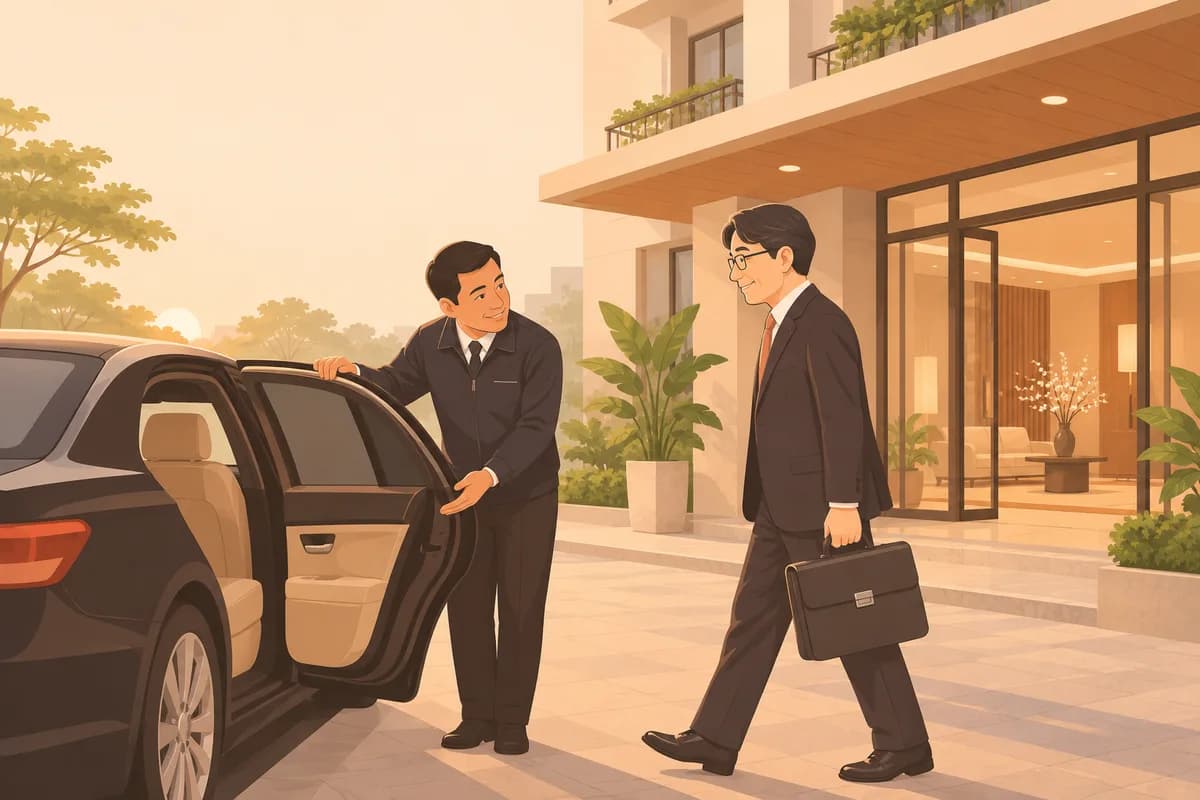
At six-thirty in the morning, you park in front of the lobby of an apartment complex in Hanoi. Mr. Yamamoto, department head at a Japanese company with a factory in Bac Ninh, steps out with his briefcase in hand. He greets you very quietly and asks something about today's schedule where you only catch the word 会議. This is a normal morning for a contract driver for a Japanese company: the same person, the same route, but every day one new task, picking someone up from headquarters, going to the airport, or driving guests home after an evening reception.
This job is different from driving Grab in that the passengers are not strangers. You see them every day, so the way you speak gets heard over and over, and one wrong form of address gets repeated wrong hundreds of times. Taxi and hire-car drivers in Japan hit the same rhythm too; the only difference is signs and paperwork are in Japanese.
This article follows one day of driving for Japanese clients: word lists section by section, five grammar spots drivers often get wrong, three real situations, and how to practice between waits. At the end there is a set of 40 words to play with right away.
- Driving for Japanese clients at a company: what to call whom, who sits where
- Forty words across one day of driving
- Grammar: five spots drivers often get wrong
- Three real situations: picking up the boss, going to the airport, the business card case
- Practice between waits
- Quick questions, short answers
- The first thing to do
Driving for Japanese clients at a company: what to call whom, who sits where
At a Japanese company, people address each other by job title. You will hear 山本部長 (Department head Yamamoto), 田中課長 (Section chief Tanaka) instead of bare names. For a driver, the safest approach is to call the boss by surname plus title, and call unfamiliar guests お客様. Avoid あなた, because that word sounds like you are talking to an equal.
| Word | Reading | Meaning | When to use |
|---|---|---|---|
| 駐在員 | ちゅうざいいん | Japanese staff posted abroad long-term | What people call your monthly client group. |
| 部長 | ぶちょう | department head, division director | Use with surname: 山本部長. |
| 秘書 | ひしょ | secretary | The person who often calls to change your schedule. |
| 送迎 | そうげい | pick-up and drop-off | The general term for your job. |
| 接待 | せったい | evening entertainment for guests | Late trips, often returning after midnight. |
| 上座 | かみざ | seat of honor for the highest-ranking person | Ask in advance who sits where. |
| 下座 | しもざ | lowest seat | Usually the seat closest to the driver. |
Seating order for 上座 and 下座 is real in Japanese companies. When several people ride together, whoever is in charge usually knows who sits where, so ask 「どちらにお座りになりますか」 or have the secretary say beforehand, then open the right door. Do not decide on your own and do not wait for guests to figure it out.
Tips are almost nonexistent in driving in Japan, and many Japanese in Vietnam keep that habit. They often show appreciation another way: asking you to drive regularly, mentioning your name to newcomers, introducing you to colleagues. Tourists vary; some give extra. When you receive it, accept and say ありがとうございます; do not refuse for too long.
Forty words across one day of driving
The tables follow the order of one day, from receiving the job to parking at night. Each table has kana readings, because kanji is often read differently from what you guess. Katakana is left as written because it already is the reading.
Receiving the job and pick-up point
| Word | Reading | Meaning | Example sentence | Translation |
|---|---|---|---|---|
| 乗客 | じょうきゃく | passenger | 今日の乗客は3名です。 | There are 3 passengers today. |
| 運転手 | うんてんしゅ | driver | 運転手のグエンと申します。 | I am the driver; my name is Nguyen. |
| 乗車 | じょうしゃ | boarding, ride | ご乗車ありがとうございます。 | Thank you for riding with us. |
| 予約 | よやく | reservation, booking | ご予約のお名前を伺えますか。 | May I ask the name on the reservation? |
| 乗車地点 | じょうしゃちてん | pick-up point | 乗車地点はこちらでお間違いないでしょうか。 | The pick-up point is here, is that correct? |
| 目的地 | もくてきち | destination | 目的地は工場の正門でよろしいですか。 | Is the destination the factory main gate? |
| 住所 | じゅうしょ | address | 住所を見せていただけますか。 | Could you show me the address? |
| 迎えに行く | むかえにいく | go to pick up | 10分後にお迎えに行きます。 | I will come to pick you up in ten minutes. |
| 降ろす | おろす | let off, drop off | 玄関の前で降ろしますね。 | I will drop you off in front of the entrance. |
| キャンセルする | キャンセルする | cancel the trip | キャンセルされる場合は、早めにご連絡ください。 | If you cancel, please contact me early. |
予約 and 乗車 get mixed up easily. 予約 is booking in advance; 乗車 is when the passenger has already gotten in, so you say ご予約 when confirming and ご乗車 when thanking. The sentence 「迎えに行きます」 is only for saying when you will arrive to pick someone up, not when they are already standing in front of you.
Luggage and seating in the car
| Word | Reading | Meaning | Example sentence | Translation |
|---|---|---|---|---|
| 荷物 | にもつ | luggage | お荷物をお持ちしましょうか。 | Shall I carry your luggage? |
| トランク | トランク | trunk | トランクを開けますので、少々お待ちください。 | I will open the trunk; please wait a moment. |
| シートベルト | シートベルト | seat belt | シートベルトをお願いします。 | Please fasten your seat belt. |
| チャイルドシート | チャイルドシート | child seat | チャイルドシートをご用意しましょうか。 | Shall I prepare a child seat? |
| エアコン | エアコン | air conditioning | エアコンの温度はいかがですか。 | How is the air conditioning temperature? |
Japanese clients often carry work briefcases and keep them close. With small items like that they usually hold them themselves, so ask once and stop, do not grab.
Airport, hotel, and visiting guests
| Word | Reading | Meaning | Example sentence | Translation |
|---|---|---|---|---|
| 空港 | くうこう | airport | 空港まで約45分です。 | It takes about 45 minutes to the airport. |
| ターミナル | ターミナル | terminal | 第2ターミナルでよろしいですか。 | Is Terminal 2 correct? |
| ホテル | ホテル | hotel | ホテルの入り口に着きました。 | We have arrived at the hotel entrance. |
| 観光客 | かんこうきゃく | tourist | この辺りは観光客が多いので、少し混みます。 | This area has many tourists so it is a bit crowded. |
Guests from headquarters often stay at a downtown hotel a few nights then go home, so you pick them up at the airport more than at home. Then 「ホテルまでご案内いたします」 is a familiar opening line.
The route: traffic jams, detours, and turns
| Word | Reading | Meaning | Example sentence | Translation |
|---|---|---|---|---|
| 渋滞 | じゅうたい | traffic jam | この時間は渋滞しています。 | At this hour there is traffic. |
| ラッシュアワー | ラッシュアワー | rush hour | ラッシュアワーを避けて、7時に出発しましょう。 | Let's leave at 7 to avoid rush hour. |
| 迂回 | うかい | detour | 工事中なので迂回します。 | Road work, so I will detour. |
| 近道 | ちかみち | shortcut | 近道を使ってもよろしいでしょうか。 | May I take a shortcut? |
| 通行料 | つうこうりょう | toll | 通行料は別になります。 | The toll is charged separately. |
| 高速道路 | こうそくどうろ | expressway | 高速道路を使うと早く着きます。 | Using the expressway gets us there faster. |
| 交差点 | こうさてん | intersection | 次の交差点を右折します。 | At the next intersection I will turn right. |
| 左折 | させつ | left turn | 前方で左折いたします。 | Up ahead I will turn left. |
| 右折 | うせつ | right turn | この先で右折します。 | Farther on I will turn right. |
| 制限速度 | せいげんそくど | speed limit | 制限速度を守って走ります。 | I will drive within the speed limit. |
| 駐車場 | ちゅうしゃじょう | parking lot | 駐車場は建物の裏側にございます。 | The parking lot is behind the building. |
| ガソリン | ガソリン | gasoline | ガソリンを入れてもよろしいでしょうか。 | May I stop for gas? |
| ナビ | ナビ | navigation, GPS | ナビの案内どおりに進みます。 | I will follow the navigation directions. |
When announcing directions, people in the trade often say briefly 「次を右です」 with colleagues, but with guests say the full 「次の交差点を右折いたします」. 右折 and 左折 are only for vehicles; pedestrians say 右に曲がる, 左に曲がる.
Fare, receipt, forgotten items, and documents
| Word | Reading | Meaning | Example sentence | Translation |
|---|---|---|---|---|
| 運賃 | うんちん | fare | 運賃は250,000ドンです。 | The fare is 250,000 dong. |
| 支払い | しはらい | payment | お支払いはどうなさいますか。 | How would you like to pay? |
| 現金 | げんきん | cash | 現金でもカードでも結構です。 | Cash or card is fine. |
| 領収書 | りょうしゅうしょ | receipt | 領収書が必要でしたら、お申し付けください。 | If you need a receipt, please let me know. |
| チップ | チップ | tip | チップまでいただき、ありがとうございます。 | Thank you for the tip as well. |
| 評価 | ひょうか | rating, stars | アプリで星の評価をいただけると助かります。 | A star rating on the app would help me a lot. |
| 忘れ物 | わすれもの | forgotten item | お忘れ物はございませんか。 | Did you leave anything behind? |
| 運転免許証 | うんてんめんきょしょう | driver's license | 運転免許証と車の書類は常に携帯しております。 | I always carry my license and vehicle documents. |
For a Japanese company, 領収書 is the most important word in the whole table. Accounting needs a receipt with the company name, called 宛名 (あてな), so you will be asked 「宛名はどうなさいますか」 and must write the company name correctly in Latin letters.
Money amounts are where Vietnamese speakers slip most, because Japanese counts in 万 (ten thousand), not in thousands.
| Amount | Written form | Reading |
|---|---|---|
| 25.000 đồng | 2万5000ドン | にまんごせんどん |
| 120.000 đồng | 12万ドン | じゅうにまんどん |
| 250.000 đồng | 25万ドン | にじゅうごまんどん |
| 1.200.000 đồng | 120万ドン | ひゃくにじゅうまんどん |
Grammar: five spots drivers often get wrong
1. お〜ください and 〜をお願いします: inviting the guest to do something
The pattern お + verb in ます form minus ます + ください is the polite way to invite a guest to do something. With nouns, use ご + noun + ください. 〜をお願いします is when you ask the guest for one specific thing, briefly.
- どうぞお乗りください。
- 足元にお気をつけください。
- シートベルトをお願いします。
- ご確認をお願いいたします。
Learners often use plain 〜てください (乗ってください, 見てください). That is grammatically correct but sounds like instructing someone lower than you. With guests, stick to お〜ください.
2. 〜ましょうか and 〜ますね: offering help and announcing beforehand
When you want to do something for the guest, use 〜ましょうか. When you are about to do something right in front of them, use 〜ますね to announce it.
- お荷物をお持ちしましょうか。
- 窓を少し開けましょうか。
- トランクを開けますね。
- 少し揺れますので、お気をつけください。
A common mistake is staying silent to go faster, or asking curtly 「荷物?」. It is short, but to Japanese guests it sounds like you are grabbing their things. A full sentence costs only a few extra syllables.
3. 〜てもよろしいでしょうか: asking permission before changing the plan
Use when you want to take the expressway, a shortcut, stop for gas, or turn on music. This pattern asks permission, not a vague opinion. The short form 〜てもいいですか is still polite with friendly guests, but use the long form the first time you meet.
- 高速道路を使ってもよろしいでしょうか。
- 近道を通ってもよろしいですか。
- 途中でガソリンを入れてもよろしいでしょうか。
A common mistake is asking 「高速、行きますか」 as if the guest decides everything. Guests usually do not know the roads and need you to propose with a reason: 「高速を使うと15分早く着きますが、通行料が別にかかります」.
4. 〜になります and 〜です: stating the amount
When stating money, 〜です is enough and clear. 〜になります sounds softer and is very common in service, so you will hear it a lot. Some Japanese find 〜になります a bit redundant, but guests do not fault you for it. What makes guests uncomfortable is reading the number wrong.
- 運賃は250,000ドンになります。
- 通行料を含めて280,000ドンです。
- お釣りは50,000ドンです。
Use the 万 table above to practice. Vietnamese speakers think in thousands so they often say something like 「250千」, while Japanese guests understand right away when they hear 25万.
5. 〜ています and 〜ております: reporting the situation and apologizing
When traffic is bad, guests want to hear what is happening and how much longer. 〜ています describes the current state; 〜ております is the more humble form. Pair it with 申し訳ございません or お待たせいたしました, say it once, then move to information.
- この先で工事をしております。
- 渋滞していますので、少し遅れます。
- お待たせいたしました。あと5分ほどで到着します。
Learners often say 渋滞しました (traffic was jammed) because they are used to past tense, while guests want to know whether the car is in a jam now. Use ています for anything happening now.
Three real situations: picking up the boss, going to the airport, the business card case
Morning pick-up for Mr. Yamamoto
This is the trip taking Mr. Yamamoto from the apartment complex to the factory. Read both roles aloud.
| Role | Japanese | Translation |
|---|---|---|
| Driver | おはようございます、山本部長。 | Good morning, Mr. Yamamoto. |
| Mr. Yamamoto | おはよう。今日は少し早めに出てもらえますか。 | Good morning. Can you leave a little early today? |
| Driver | かしこまりました。今朝は国道が渋滞しておりますが、高速道路を使ってもよろしいでしょうか。 | Understood. The national highway is jammed this morning; may I use the expressway? |
| Mr. Yamamoto | ああ、お願いします。9時に会議があるので。 | Yes, please. I have a meeting at 9. |
| Driver | 承知しました。通行料は後ほど月の精算にまとめます。 | Understood. I will include the toll in the monthly settlement later. |
| Mr. Yamamoto | それでいいです。エアコン、少し弱くしてもらえますか。 | That is fine. Can you turn the air conditioning down a bit? |
| Driver | はい、すぐ調整します。8時15分には工場に着く予定です。 | Yes, I will adjust it right away. We should reach the factory by 8:15. |
Seeing a business guest off at the airport and requesting a receipt
| Role | Japanese | Translation |
|---|---|---|
| Driver | 鈴木様、空港まで約45分です。お荷物はトランクに入れておきましたので、ご安心ください。 | Mr. Suzuki, it is about 45 minutes to the airport. I have put your luggage in the trunk, so please rest assured. |
| Mr. Suzuki | ありがとう。昨日の夜の接待のタクシー代も、領収書をもらえますか。 | Thank you. For last night's entertainment taxi as well, can I get a receipt? |
| Driver | はい、ご用意しております。宛名は会社名でよろしいでしょうか。 | Yes, I have it ready. Should the addressee be the company name? |
| Mr. Suzuki | はい、会社名でお願いします。 | Yes, the company name please. |
| Driver | かしこまりました。第2ターミナルに到着しました。お忘れ物はございませんか。 | Understood. We have arrived at Terminal 2. Did you leave anything behind? |
| Mr. Suzuki | 大丈夫です。お世話になりました。 | I am fine. Thank you for your help. |
| Driver | こちらこそ、ありがとうございました。またお待ちしております。 | Thank you. I look forward to seeing you again. |
The forgotten business card case
After an evening reception, the driver finds a 名刺入れ (business card case) left on the back seat. He calls Mr. Yamamoto's secretary.
| Role | Japanese | Translation |
|---|---|---|
| Driver | もしもし、運転手のグエンです。山本部長の名刺入れが後部座席にございました。 | Hello, this is driver Nguyen. Mr. Yamamoto's business card case was on the back seat. |
| Secretary | ありがとうございます。部長はいま会議中です。 | Thank you. The department head is in a meeting now. |
| Driver | では、明日の朝、お迎えのときにお渡ししましょうか。 | Then shall I hand it to him tomorrow morning when I pick him up? |
| Secretary | それで大丈夫だと思いますが、中に大事な名刺が入っているので、今日中に会社へ届けてもらえますか。 | That should be fine, but there are important business cards inside, so could you bring it to the company today? |
| Driver | 承知しました。1時間以内に伺います。 | Understood. I will come within one hour. |
What to remember here is 「中に大事な名刺が入っている」: Japanese describe the reason for urgency instead of giving orders. When you hear that clause, the right move is to act immediately without waiting for them to say it outright.
Practice between waits
Open Falling Stars or Pop It with the driver word deck before starting the engine in the morning. For Japanese, the goal of the first round is recognizing characters: see 渋滞 or 迂回 and know the meaning right away, no need to read aloud yet. Kana readings come later, when you read the example sentences aloud.
Listening should start with your actual client's voice. Pick a short episode from the Japanese podcast, copy each sentence, and watch endings like 〜ましょうか and 〜ますね, because that is where Vietnamese ears often slip. Once that feels familiar, look at courses and take the vocabulary test to see your current word stock.
Outside WELE: Japan Foundation's Irodori textbook is free and teaches everyday Japanese cleanly; it fits a foundation step. The most practical study is listening to your own boss. Record the three sentences they say most each week, ask the secretary the meaning, then say them back yourself. To try measuring, take a JLPT mock test on WELE.
Many contract drivers for Japanese companies also pick up guests at hotels, so it is worth reading next Japanese for hotels and Japanese for tour guides. The full category is at Japanese by profession, and the driver page collects every article for this job.
Quick questions, short answers
How much Japanese does a driver need?
For one Japanese company, the 40 words above plus about twenty fixed sentences are usually enough for most of the workday: greetings, confirming the schedule, asking permission to change route, giving times, handing over receipts, seeing guests off. The rest you learn gradually from the people you drive.
How should you address a Japanese boss?
Surname plus title, like 山本部長, or surname plus さん if the title is unclear. Do not use given names and do not use あなた. If unsure, ask the secretary once and write down the correct form for each person.
Do Japanese people tip?
In Japan driving almost never involves tips, and many Japanese in Vietnam keep that habit. Some still give extra, especially when traveling. Do not ask and do not wait; accept when offered and thank them.
Katakana first or kanji first?
Katakana first. Hotel names, restaurant names, and places clients give you are all in katakana, and words like トランク, ターミナル, ナビ in this set too. Learn kanji from the tables, a few characters each week.
What should Vietnamese people prepare to drive taxi in Japan?
Ask the hiring company directly about the passenger-car license type (第二種免許), residence status, and current Japanese requirements, because conditions change over time and by company. The Japanese for the job is close to what this article teaches, plus reading maps and local road signs.
The first thing to do
Pick three sentences for talking to the boss each morning from the tables above, copy them on paper, and say them aloud on the first run tomorrow. When that feels familiar, add one new sentence each week, or play one round of the deck in Falling Stars before starting the engine.
