Japanese for Tour Guides: Vocabulary, Keigo, and Leading Japanese Guests in Hoi An
On this page
- What Japanese guests listen for in a guide
- Vocabulary for one day in Hoi An
- Meeting guests, schedule, and boarding
- Sightseeing and commentary
- Shopping, gifts, and tips
- Safety, incidents, and complaints
- Five ways of speaking you will keep using on the bus and in the old town
- 1. お〜ください, ご〜ください, and 〜ていただけますか
- 2. 〜ので + request: give the reason, then ask
- 3. 〜いたします and お待ちしております: talking about your own actions
- 4. 〜と言われています and 〜そうです: telling history without overclaiming
- 5. 〜までに, 〜まで, and 〜に: time and deadlines
- Three sample scenes: on the bus, on the bridge, when a guest is missing
- On the bus from Da Nang to Hoi An
- In front of the Japanese Covered Bridge
- One guest has not returned on time
- How to practice when the tour schedule is packed
- Frequently asked questions
- What JLPT level does a Japanese-speaking tour guide need?
- How much keigo is enough?
- What if older Japanese guests cannot hear clearly?
- When telling Hoi An’s history in Japanese, do figures need to be exact?
- Do you have to learn every kanji in the vocabulary tables?
- Next trip
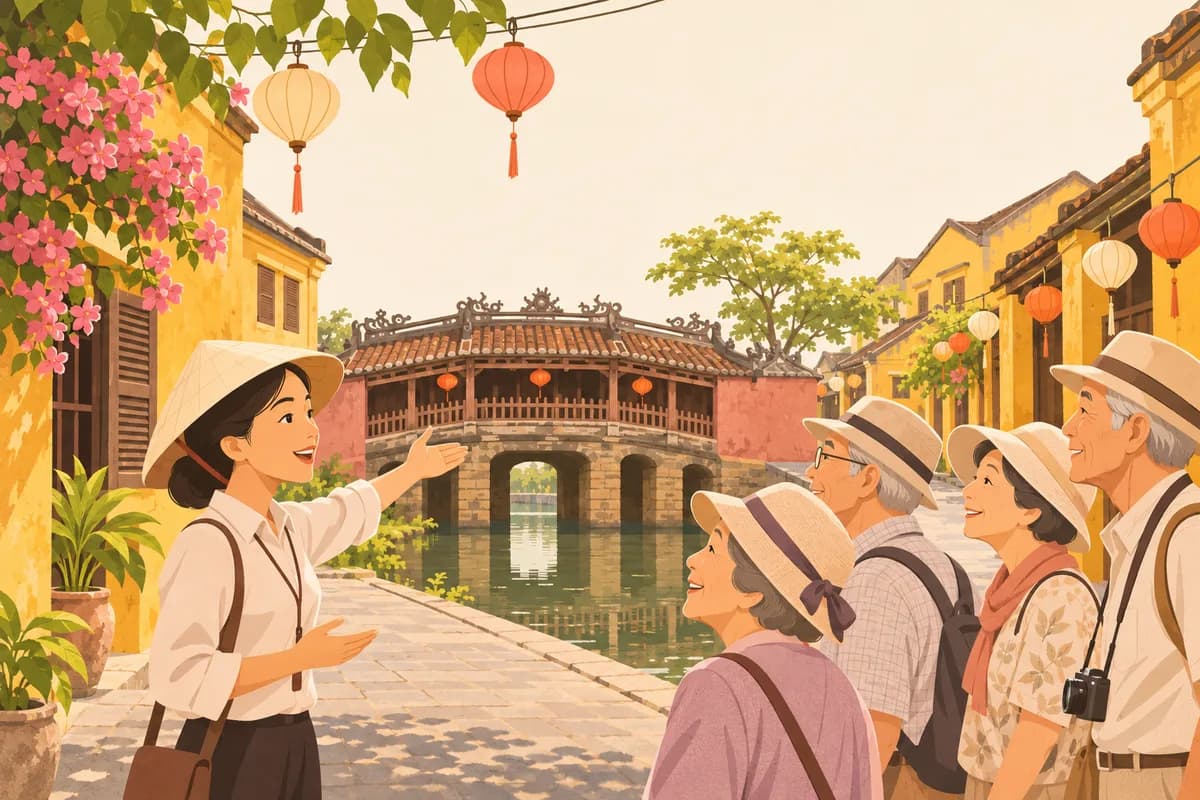
A small bus carrying the group leaves the hotel in Da Nang, heading for Hoi An. A dozen or so Japanese guests, mostly retired couples, sit neatly with wide-brimmed hats on their laps. You hold the microphone, introduce yourself, and on the second sentence an elderly woman raises her hand and asks: 「ガイドさん、トイレはどこですか」. You understand every word, but you are not sure which way of speaking you should answer in.
Japanese guests often pay attention to how you speak, not just the content. They are used to service with clear honorific language, punctuality to the minute, and they expect the guide to announce every change in advance. A line as blunt as 「バスに乗ってください」 said to exactly these guests will sound colder than you think.
If you are guiding or about to guide Japanese guests in Vietnam, this article uses one day in Hoi An as a frame: vocabulary tables by time of day, keigo that is enough for guests, five sentence patterns, three sample scenes with translation and how to practice, including a word set you can use right away.
- What Japanese guests listen for in a guide
- Vocabulary for one day in Hoi An
- Five ways of speaking you will keep using on the bus and in the old town
- Three sample scenes: on the bus, on the bridge, when a guest is missing
- How to practice when the tour schedule is packed
- Frequently asked questions
- Next trip
What Japanese guests listen for in a guide
There are three kinds of listener, and each kind needs a different level of politeness. The table below describes what you usually hear and say in one day.
| Who you speak to | Speech style commonly used | Example |
|---|---|---|
| Guests in the group | Keigo: お〜ください, 〜いたします, address as お客様 or 〜様 | こちらからお入りください。 |
| Group leader or staff from the Japanese company | です・ます, short clear reports | 15時30分にバスが出ます。 |
| Driver, local partners | Vietnamese, or simple Japanese if they know it | Report time and parking spot, no keigo |
With guests, you do not need the highest level of keigo. The goal is to sound respectful and clear: お〜ください when inviting someone to do something, 〜いたします when talking about your own actions, and です・ます everywhere else. Keigo pushed too far also makes sentences longer, while guests standing in the sun need to hear things fast.
One thing that is easy to overlook is the order of information. Japanese guests usually want to know the time, place, and duration first, then the reason. Practice speaking in that order: 「3時までにこちらにお戻りください。自由時間は45分です。」
Vocabulary for one day in Hoi An
The four tables below follow the order of one day. Readings in kana are included, because kanji in place names and travel terms are often read differently from what you guess. The set of 40 words in the game at the end of the article fits entirely in these tables, plus a few extra words. Example sentences are things you say to guests, so they are all in polite form.
Meeting guests, schedule, and boarding
| Word | Reading | Meaning | Example sentence | Translation |
|---|---|---|---|---|
| ガイド | ガイド | tour guide | 本日ご案内いたします、ガイドのミンと申します。 | Today I will be your guide; my name is Minh, and I am a tour guide. |
| 観光客 | かんこうきゃく | sightseeing visitor | 観光客が多い時間帯ですので、お荷物にご注意ください。 | This is a busy time for visitors, so please watch your luggage. |
| 団体客 | だんたいきゃく | group tour guests | 団体客の方は、こちらの入口からお入りください。 | Group guests, please enter through this entrance. |
| 旅程 | りょてい | itinerary | 本日の旅程を簡単にご説明します。 | I will briefly explain today’s itinerary. |
| 集合場所 | しゅうごうばしょ | meeting point | 集合場所は、橋の手前のカフェの前です。 | The meeting point is in front of the café just before the bridge. |
| 出発時間 | しゅっぱつじかん | departure time | バスの出発時間は15時30分です。 | The bus departure time is 3:30 p.m. |
| 人数確認 | にんずうかくにん | head count | バスに乗る前に、人数確認をさせてください。 | Before boarding the bus, please allow me to count everyone. |
| 観光バス | かんこうバス | tour bus | 観光バスは橋の反対側に停まっています。 | The tour bus is parked on the other side of the bridge. |
| 荷物 | にもつ | luggage | 大きいお荷物はバスに置いて行ってください。 | Please leave large luggage on the bus. |
| パスポート | パスポート | passport | パスポートは、ホテルの金庫に入れてお出かけください。 | Please leave your passport in the hotel safe before going out. |
| 旅行会社 | りょこうがいしゃ | travel agency | 昼食は旅行会社が手配したレストランです。 | Lunch is at a restaurant arranged by the travel agency. |
| 乗車する | じょうしゃする | to board (a vehicle) | 皆さま、順番にご乗車ください。 | Everyone, please board in order. |
| 集合する | しゅうごうする | to gather | 12時にここにご集合ください。 | Please gather here at 12 o’clock. |
| 自由時間 | じゆうじかん | free time | 自由時間は45分です。 | Free time is 45 minutes. |
| トイレ | トイレ | restroom | トイレは、あちらの建物の奥にあります。 | The restroom is at the back of that building over there. |
| マイク | マイク | microphone | 後ろの方、聞こえますか。マイクの音量を上げますね。 | Can those in the back hear me? I will turn up the microphone volume. |
Two words that are easy to confuse are 集合する and 集合場所. The first is a verb about the act of gathering; the second is a noun for the place. When telling guests, you usually combine both: 「集合場所は橋の前です。12時にご集合ください。」
Sightseeing and commentary
| Word | Reading | Meaning | Example sentence | Translation |
|---|---|---|---|---|
| 観光 | かんこう | sightseeing | 午前中は旧市街を観光します。 | This morning we will tour the old town. |
| 史跡 | しせき | historic site | 旧市街には、古い商家や会館などの史跡が残っています。 | In the old town, historic sites such as old merchant houses and assembly halls remain. |
| 寺院 | じいん | temple | 寺院に入るときは、肩とひざが隠れる服装でお願いします。 | When entering a temple, please wear clothing that covers your shoulders and knees. |
| 博物館 | はくぶつかん | museum | 博物館では、フラッシュ撮影はご遠慮ください。 | In the museum, please refrain from flash photography. |
| チケット | チケット | ticket | 古い町の共通チケットは、入口で私がお配りします。 | I will hand out the old-town combined ticket at the entrance. |
| 行列 | ぎょうれつ | queue, line | 橋の前に行列ができていますので、先に近くのお店でお待ちください。 | There is a long line in front of the bridge, so please wait first in a nearby shop. |
| 説明する | せつめいする | to explain | この橋の由来を簡単にご説明しますね。 | Let me briefly explain the origin of this bridge. |
| 歴史 | れきし | history | 17世紀には、日本人が住んだ町があったと言われています。 | It is said that in the 17th century there was a district where Japanese people lived. |
| 文化 | ぶんか | culture | ホイアンは、日本・中国・ベトナムの文化が混ざった町です。 | Hoi An is a town where Japanese, Chinese, and Vietnamese cultures blend. |
| 風習 | ふうしゅう | custom | 満月の夜に、川に灯籠を流す風習があります。 | On full-moon nights there is a custom of floating lanterns on the river. |
| 祭り | まつり | festival | 毎月の満月の夜には、ランタン祭りが開かれます。 | On each full-moon night, a lantern festival is held. |
| 郷土料理 | きょうどりょうり | local cuisine | お昼は郷土料理のカオラウをご用意しています。 | For lunch we have prepared cao lau, a local dish. |
| 通訳 | つうやく | interpretation | 現地のガイドは日本語が話せませんので、私が通訳いたします。 | The local guide here does not speak Japanese, so I will interpret. |
| 天気 | てんき | weather | 午後は天気が崩れるそうですので、傘をお持ちください。 | It looks like the weather will turn bad this afternoon, so please bring an umbrella. |
If a guest asks why Hoi An has the characters 「日本橋」 or 「来遠橋」, you will need to use a string of words from this table at once: 歴史, 文化, 説明する. Practice saying it in three short sentences instead of one long sentence with many clauses, because guests are listening through a microphone amid street noise.
Shopping, gifts, and tips
| Word | Reading | Meaning | Example sentence | Translation |
|---|---|---|---|---|
| お土産 | おみやげ | souvenir | お土産はこの先のお店でご覧いただけます。 | You can view souvenirs at the shop ahead. |
| 土産物店 | みやげものてん | souvenir shop | 土産物店には30分ほど立ち寄ります。 | We will stop at a souvenir shop for about 30 minutes. |
| 名産品 | めいさんひん | local specialty product | ホイアンの名産品は、ランタンと絹製品です。 | Hoi An’s specialties are lanterns and silk products. |
| チップ | チップ | tip | ガイドへのチップは、お気持ちで結構です。 | Tips for the guide are entirely at your discretion. |
When a guest asks whether tipping is required, answer briefly and without pressure: お気持ちで結構です is a natural, sufficient line. Do not give a long explanation of customs, because that easily sounds like a hint.
Safety, incidents, and complaints
| Word | Reading | Meaning | Example sentence | Translation |
|---|---|---|---|---|
| 安全 | あんぜん | safety | 道が滑りやすいですので、安全のため手すりをお持ちください。 | The path is slippery, so for safety please hold the handrail. |
| 応急手当 | おうきゅうてあて | first aid | 具合が悪くなったら、すぐに私にお知らせください。応急手当の用意があります。 | If you feel unwell, please tell me right away. I have first-aid supplies ready. |
| 旅行保険 | りょこうほけん | travel insurance | 海外旅行保険の連絡先は、お手元のしおりに書いてあります。 | The contact number for overseas travel insurance is written in the booklet you have with you. |
| クレーム | クレーム | complaint | お客様からクレームがあった場合は、すぐに旅行会社に報告します。 | If a guest lodges a complaint, I will report it to the travel agency immediately. |
| 払い戻し | はらいもどし | refund | 雨でボートが運休になったため、料金は払い戻しいたします。 | Because rain canceled the boat service, we will refund the fee. |
| 遅れ | おくれ | delay | 渋滞のため、到着に20分ほど遅れが出ています。 | Because of traffic, arrival is delayed by about 20 minutes. |
Note on クレーム: when speaking directly to guests, use softer words such as ご意見 or ご不満な点 instead of クレーム. That word sounds like a company label; few people say “I have a complaint” that way about themselves. Use クレーム only in internal reports.
Five ways of speaking you will keep using on the bus and in the old town
The five patterns below cover most of what you say in a day. Learn them as chunks, not word by word.
1. お〜ください, ご〜ください, and 〜ていただけますか
When inviting guests to do something, the most formal pattern for service staff is お + verb in ます form minus ます + ください, or ご + Sino-Japanese noun + ください. Plain 〜てください is still polite; 〜ていただけますか is for asking something that takes a bit of effort.
- こちらからお入りください。
- 順番にご乗車ください。
- お名前をもう一度お聞かせいただけますか。
A common mistake among Vietnamese learners is using 〜てください for every invitation, including boarding, because it is the first pattern they learned. With older guests, 「乗ってください」 sounds more blunt than 「お乗りください」 or 「ご乗車ください」. Memorize the three patterns that go with the most frequent actions: お乗りください, お待ちください, ご注意ください.
2. 〜ので + request: give the reason, then ask
Japanese guests are used to hearing the reason first, the instruction second. 〜ので links reason and request and makes the sentence much softer than 〜から. A typical structure is 「理由 + ですので、〜ください」.
- 足元が滑りやすいですので、ご注意ください。
- お時間がありませんので、こちらからお急ぎください。
- 日差しが強いですので、水分をこまめにお取りください。
Learners often use 〜から because it resembles “because… so” in Vietnamese. 「滑りやすいから注意してください」 sounds like speech to friends. In service, 〜ので or 〜ですので is the default choice.
3. 〜いたします and お待ちしております: talking about your own actions
When talking about what you do, use humble language: ご案内いたします, ご説明します, お待ちしております, 通訳いたします. They show guests you put them first without having to say it outright.
- それでは、旧市街をご案内いたします。
- 15時にバスの前でお待ちしております。
- ご不明な点は、私が通訳いたします。
A common mistake is mixing systems: saying 「ご案内になります」 about yourself, which is honorific form for someone else. A quick rule: your actions go with いたします or させていただきます; guest-related actions go with お〜になる or ご〜ください. Also do not overuse 〜させていただきます: once at the start of the day is enough.
4. 〜と言われています and 〜そうです: telling history without overclaiming
When telling old stories or legends, use 〜と言われています, 〜とされています, or 〜そうです to signal that this is what people say. If you state things flatly as 〜です, guests will take it as verified fact.
- この橋は17世紀に造られたと言われています。
- 橋の両端には猿と犬の像があります。
- 昔は日本人の商人が多く住んでいたそうです。
Learners often tell history as a chain of flat assertions because they fear sounding unsure. With Japanese guests it is the opposite: stating the source of information sounds more trustworthy. For details you are not sure of, say 〜と言われています and do not attach a specific year.
5. 〜までに, 〜まで, and 〜に: time and deadlines
Japanese guests care a lot about time, so these three particles must be correct. 〜に marks a point in time, 〜までに marks a deadline by which something must be done, and 〜まで marks something continuing until that point.
- 3時までにバスにお戻りください。
- 3時まで自由時間です。
- バスは15時30分に出発します。
A frequent mistake is saying 「3時までバスに戻ってください」, which implies guests must keep “returning to the bus” continuously until 3 o’clock, which sounds absurd. The correct line is 「3時までに」. When counting people, use 〜名様 or 〜名: 「全部で24名様です」.
Three sample scenes: on the bus, on the bridge, when a guest is missing
Read both roles aloud, then try translating back from the English column into Japanese.
On the bus from Da Nang to Hoi An
| Role | Japanese | Translation |
|---|---|---|
| Guide | 皆さま、おはようございます。本日ご案内いたします、ガイドのミンと申します。 | Good morning, everyone. I will be your guide today; my name is Minh, and I am a tour guide. |
| Guide | これから約40分で、ホイアンに到着します。到着後は、まず旧市街を歩いて観光します。 | In about 40 minutes we will arrive in Hoi An. After arrival, we will first walk and tour the old town. |
| Guest | ガイドさん、トイレはどこですか。 | Guide, where is the restroom? |
| Guide | 到着したらすぐにご案内します。もし途中で気分が悪くなったら、遠慮なくおっしゃってください。 | When we arrive I will show you right away. If you feel unwell on the way, please do not hesitate to say so. |
| Guest | 午後は雨になりそうですね。 | It looks like it might rain this afternoon. |
| Guide | そうですね。傘は車内にありますので、必要な方はお声がけください。 | That’s right. There are umbrellas on the bus, so if you need one please let me know. |
In front of the Japanese Covered Bridge
Practice reading this passage at a slow pace, pausing by idea, as when you speak in front of a line of people taking photos.
| Section | Japanese | Translation |
|---|---|---|
| Pointing | 皆さま、こちらをご覧ください。これが来遠橋、通称「日本橋」です。 | Everyone, please look this way. This is Lai Vien Bridge, commonly called the “Japanese Bridge.” |
| Background | 17世紀の初めに、日本人の商人たちによって造られたと言われています。 | It is said to have been built by Japanese merchants in the early 17th century. |
| Detail | 橋の両端には、猿と犬の像があります。見つけられましたか。 | At both ends of the bridge there are statues of a monkey and a dog. Did you find them? |
| Heritage | ホイアンの旧市街は、1999年に世界遺産に登録されました。 | Hoi An’s old town was registered as a World Heritage site in 1999. |
| Instruction | 橋の上は混み合いますので、順番にお渡りください。 | The bridge is crowded, so please cross one at a time in order. |
| Time | 45分の自由時間のあと、この橋の手前に15時までにお戻りください。 | After 45 minutes of free time, please return to this spot before the bridge by 3 p.m. at the latest. |
One guest has not returned on time
| Role | Japanese | Translation |
|---|---|---|
| Guide | 皆さま、人数確認をします。お一人足りないようです。 | Everyone, I will do a head count. It seems we are one person short. |
| Guest | 田中さんのご主人が、お土産のお店に行きました。 | Mrs. Tanaka’s husband went to the souvenir shop. |
| Guide | 承知しました。お電話してみますので、少々お待ちください。 | Understood. I will try calling, so please wait a moment. |
| Guide | もしもし、ガイドのミンです。お客様、今どちらにいらっしゃいますか。 | Hello, this is guide Minh. Guest, where are you now? |
| Guest on phone | 橋の向こうのお店です。道に迷ってしまいました。 | I am at a shop on the other side of the bridge. I got lost. |
| Guide | そこで動かずにお待ちください。すぐにお迎えに参ります。 | Please stay where you are and wait. I will come to pick you up right away. |
How to practice when the tour schedule is packed
A long day guiding a group leaves little room for study hours, so use waiting gaps. Open the tour-guide word set in Falling Stars or Pop It while guests eat lunch, until you see kanji and remember the reading and meaning.
Listening should go together with dictation. With one episode from the Japanese podcast, listen sentence by sentence and write it down; checking again will show exactly where your ear skips, especially sentence endings and particles like 〜ので and 〜までに. The full path is in the courses; the vocabulary test tells you where you stand.
Outside WELE: the Japan Foundation’s free Irodori textbook teaches everyday Japanese very cleanly and works well as a base. Remember that the 通訳案内士 exam is Japan’s certified guide qualification for guiding inside Japan; if you guide in Vietnam you follow Vietnam’s tour-guide card rules, which have a foreign-language component and can change, so read the current regulations. When you want to check level, JLPT mock tests on WELE give you a benchmark.
Practice specific to this job: memorize one full 30-second passage about the site you guide most often and repeat it aloud at slow speed. Two jobs work alongside you in a day, front desk and driver, and each has its own article: Japanese for hotels and Japanese for drivers. Other jobs are at Japanese by profession and the tour guide page.
Frequently asked questions
What JLPT level does a Japanese-speaking tour guide need?
There is no single number. Each travel agency sets requirements for leading Japanese groups, and international tour-guide licensing has its own foreign-language section. The most practical step is to ask the company you want to join. Real-world ability is whether you catch guests’ questions and speak smoothly during commentary.
How much keigo is enough?
Enough when guests feel respected and understand immediately what you mean. For most situations, お〜ください, 〜いたします, 〜ので, and です・ます already cover nearly everything. Dense keigo meant for business letters is not needed yet.
What if older Japanese guests cannot hear clearly?
Speak more slowly, pause between ideas, and repeat the final time in numbers. Do not raise your voice too much; that distorts the sentence. Writing the time and place on a slip of paper or printing it in the handbook often helps more than saying more.
When telling Hoi An’s history in Japanese, do figures need to be exact?
Yes, but only numbers you have checked, such as the year UNESCO recognized the old town. For the rest, when the bridge was built, legends, use 〜と言われています and do not assign a specific year if you are not sure. Guests may have read a guidebook before the trip.
Do you have to learn every kanji in the vocabulary tables?
Not right away. Learn to recognize characters in words you meet daily first, such as 集合, 出発, 安全, then expand. Kana readings in the tables help you speak and listen before you can read.
Next trip
Before the next Hoi An trip, pick three sentences from the tables above, write them on a small slip, and say them to a colleague. If you want a warm-up, play one round of the word set on your phone.
