Japanese for Flight Attendants and Ground Staff: Keigo with お客様, Vocabulary, and Dialogues
On this page
- Three ways of speaking in one airport shift
- Vocabulary by leg of the trip
- Check-in counter and baggage
- Boarding gate and when the flight has problems
- In the cabin: safety
- Service and in-flight announcements
- Five keigo sentence patterns for お客様
- 1. お〜ください and ご〜ください
- 2. 恐れ入りますが and 〜ていただけますか
- 3. お〜します: what you do for the guest
- 4. 〜でございます and 〜になります
- 5. 〜かねます: saying no while staying polite
- Three dialogues and one announcement
- The Kobayashis at the counter
- Overnight Hanoi to Osaka: guest feels cold and wants sleep
- Baggage missing at Kansai
- Sample delay announcement
- Japanese interview: six questions
- Speaking and listening practice
- Quick Q&A
- What JLPT level do ground staff need?
- What is the difference between 客室乗務員 and グランドスタッフ?
- Do you need to learn all of keigo?
- Do you have to read kanji?
- What if the guest speaks too fast?
- Starting point
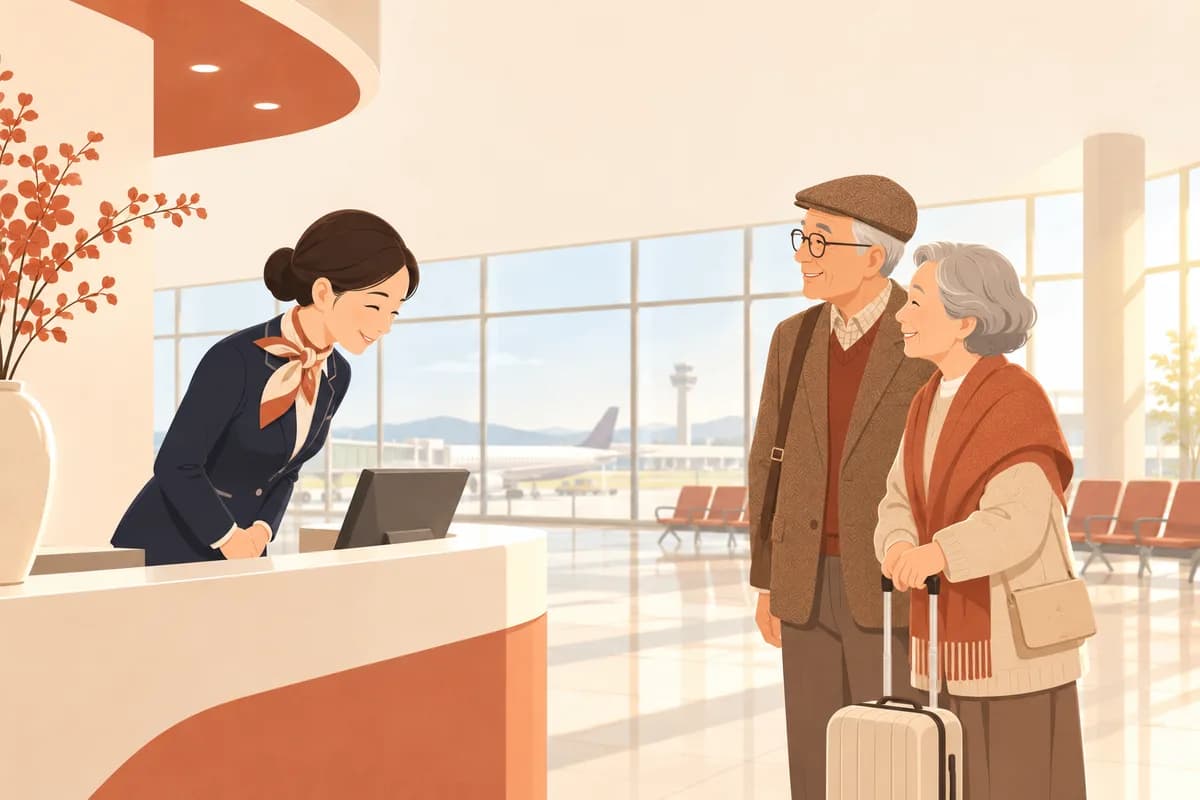
At six in the morning at the check-in counter for a flight to Narita, an elderly Japanese couple stands in front of you. She asks in a small, very fast voice; he nods after each sentence. You catch 窓側 and お荷物, but you are not sure whether she is asking for a seat or about a bag. Meanwhile the line behind you has grown longer.
Japanese at the airport has a point that general textbooks rarely mention: people call passengers お客様, not 乗客, and use keigo for every small action, from taking a passport to pointing down an aisle. The same person speaks keigo to guests in the morning, plain form with colleagues at the break room at noon, and different words again in written reports.
The sections below follow one trip in order, from counter to cabin: word tables with kana, the five keigo patterns used most often, three dialogues, one announcement, 面接 questions, and how to practice. If you are preparing to apply or just started your first shift, reading in this order will leave you least lost.
- Three ways of speaking in one airport shift
- Vocabulary by leg of the trip
- Five keigo sentence patterns for お客様
- Three dialogues and one announcement
- Japanese interview: six questions
- Speaking and listening practice
- Quick Q&A
Three ways of speaking in one airport shift
The same task, you say it differently depending on who is listening. The table below is what you usually hear at the counter and in the cabin, and what you should copy.
| Speaking to whom | Style commonly used | Example |
|---|---|---|
| Passengers (お客様) | Full keigo: お〜します, 〜でございます, お〜ください | お荷物をお預かりいたします。 |
| Colleagues, superiors | です・ます with superiors, plain form with people you know well | 12番ゲート、搭乗始まってます。 |
| Reports, shift messages | Short sentences, often ending in a noun, using 乗客 and report vocabulary | 乗客全員搭乗済み。 |
What stands out is the character 乗客. In reports you write 乗客; when speaking to that person you only use お客様. Mix them up once and guests may not notice, but Japanese colleagues will hear it right away.
Older guests often speak softly and use regional speech, especially on domestic flights. Learning one polite ask-back sentence first is worth doing: 「恐れ入りますが、もう一度お願いできますか」.
Vocabulary by leg of the trip
Vocabulary is arranged by four things you do in order on one trip: receive guests at the counter, get guests to the gate, keep safety in the cabin, then service. The kana reading column is enough, because industry kanji are often read differently from what you guess. All 42 words from the game appear in the four tables, along with a few terms like グランドスタッフ (ground staff), 預け荷物 (checked baggage), and 保安検査 (security screening).
Check-in counter and baggage
| Word | Reading | Meaning | Example sentence | Translation |
|---|---|---|---|---|
| チェックイン | チェックイン | check-in | チェックインは、あちらのカウンターで承ります。 | Check-in is handled at the counter over there. |
| 搭乗券 | とうじょうけん | boarding pass | パスポートと搭乗券を拝見いたします。 | I would like to see your passport and boarding pass. |
| 乗客 | じょうきゃく | passenger | 乗客は全員、搭乗済みです。 | All passengers have boarded. (report sentence to colleagues, not said to guests) |
| フライト | フライト | flight | 本日のフライトは、定刻どおり出発する予定です。 | Today's flight is scheduled to depart on time. |
| 手荷物 | てにもつ | baggage | お預けのお手荷物は、いくつですか。 | How many pieces of baggage are you checking? |
| 機内持ち込み | きないもちこみ | carry-on | こちらは機内持ち込みで大丈夫です。 | This one is fine as carry-on. |
| 超過手荷物 | ちょうかてにもつ | excess baggage | 申し訳ございません、こちらは超過手荷物になります。 | We are sorry, this counts as excess baggage. |
| 手荷物受取所 | てにもつうけとりじょ | baggage claim | お荷物は、手荷物受取所でお受け取りください。 | Please collect your baggage at baggage claim. |
| ロストバゲージ | ロストバゲージ | lost baggage | ロストバゲージの手続きをいたします。 | I will process the lost baggage procedure. |
| 入国審査 | にゅうこくしんさ | immigration inspection | 入国審査では、滞在先を聞かれることがあります。 | At immigration, you may be asked where you are staying. |
The character 手荷物 means baggage in general, both carry-on and checked. To be clearer, say 預け荷物 for checked items and 機内持ち込み for cabin carry-on. Many new staff mix the two and ask guests 「手荷物はいくつですか」; the guest answers with a number and you do not know which bags they mean.
Boarding gate and when the flight has problems
| Word | Reading | Meaning | Example sentence | Translation |
|---|---|---|---|---|
| ゲート | ゲート | gate | 搭乗ゲートが12番に変更になりました。 | The boarding gate has changed to number 12. |
| 搭乗 | とうじょう | boarding | ただいまより、ご搭乗を開始いたします。 | We will now begin boarding. |
| 航空機 | こうくうき | aircraft | 使用する航空機の到着が遅れております。 | The aircraft for this flight is arriving late. |
| 乗り継ぎ | のりつぎ | connection | 乗り継ぎの時間は、1時間30分ございます。 | Your connection time is 1 hour 30 minutes. |
| 遅延 | ちえん | delay | 天候の影響で、約40分の遅延が発生しております。 | Due to weather, there is a delay of about 40 minutes. |
| 欠航 | けっこう | flight cancellation | 大変申し訳ございません、こちらの便は欠航となりました。 | We are very sorry; this flight has been cancelled. |
| 振り替える | ふりかえる | rebook onto another flight | 次の便に振り替えることができます。 | I can rebook you on the next flight. |
| オーバーブッキング | オーバーブッキング | overbooking | オーバーブッキングのため、お席のご協力をお願いしております。 | Because of overbooking, we are asking for your cooperation regarding seats. |
Here two characters are easy to confuse: 遅延 and 欠航. 遅延 is a late departure; 欠航 is the flight not operating. Hearing one word alone can force passengers to change their whole plan, so practice hearing these two until you do not have to think.
In the cabin: safety
| Word | Reading | Meaning | Example sentence | Translation |
|---|---|---|---|---|
| 客室乗務員 | きゃくしつじょうむいん | flight attendant | 本日担当の客室乗務員の鈴木でございます。 | I am Suzuki, the flight attendant in charge today. |
| 機長 | きちょう | captain | ただいま、機長がシートベルト着用サインを点灯いたしました。 | The captain has just turned on the seatbelt sign. |
| 客室 | きゃくしつ | cabin | 客室内の温度はいかがでしょうか。 | How is the temperature in the cabin? |
| シートベルト | シートベルト | seatbelt | シートベルトをお締めください。 | Please fasten your seatbelt. |
| 締める | しめる | fasten | 腰の低い位置で、しっかり締めてください。 | Please fasten it securely low on your hips. |
| 通路 | つうろ | aisle | 通路にお荷物を置かないでください。 | Please do not place baggage in the aisle. |
| 窓側 | まどがわ | window seat | 窓側のお席と通路側のお席、どちらがよろしいですか。 | Would you prefer a window seat or an aisle seat? |
| 収納棚 | しゅうのうだな | overhead bin | お荷物は頭上の収納棚にお入れください。 | Please stow baggage in the overhead bin. |
| 非常口 | ひじょうぐち | emergency exit | 最寄りの非常口は、お客様の後ろにございます。 | The nearest emergency exit is behind you. |
| 救命胴衣 | きゅうめいどうい | life vest | 救命胴衣は座席の下にございます。 | The life vest is under the seat. |
| 酸素マスク | さんそますく | oxygen mask | 酸素マスクが自動的に落ちてきます。 | The oxygen mask will drop down automatically. |
| 安全のご案内 | あんぜんのごあんない | safety briefing | これより、安全のご案内をいたします。 | We will now give the safety briefing. |
| 応急手当 | おうきゅうてあて | first aid | 応急手当ができるお客様はいらっしゃいますか。 | Is there anyone who can provide first aid? |
When you read the safety briefing, pacing matters a lot. Many passengers are used to hearing 「お願い申し上げます」 at the end of announcements, so a sentence cut too short will sound off. Practice reading the full sentence, including the ending.
Service and in-flight announcements
| Word | Reading | Meaning | Example sentence | Translation |
|---|---|---|---|---|
| 機内食 | きないしょく | in-flight meal | 機内食は、和食と洋食がございます。どちらになさいますか。 | We have Japanese-style and Western-style meals. Which would you like? |
| カート | カート | cart | カートが通ります。少々失礼いたします。 | The cart is coming through. Excuse us for a moment. |
| ビジネスクラス | ビジネスクラス | business class | ビジネスクラスのお客様から、ご案内いたします。 | We will begin with our business class guests. |
| 乳児 | にゅうじ | infant | 乳児用のベルトをお持ちします。 | I will bring an infant belt. |
| 機内アナウンス | きないあなうんす | in-flight announcement | 機内アナウンスは、日本語と英語で行います。 | In-flight announcements are made in Japanese and English. |
| 離陸 | りりく | takeoff | 当機はまもなく離陸いたします。 | This aircraft will take off shortly. |
| 着陸 | ちゃくりく | landing | 着陸に備え、座席を元の位置にお戻しください。 | Please return your seat to its original position in preparation for landing. |
| 乱気流 | らんきりゅう | turbulence | 乱気流のため、お席にお戻りください。 | Due to turbulence, please return to your seat. |
In this table there is a small detail: 当機 is how the aircraft refers to itself in announcements, it means “this aircraft.” You will not say 当機 to guests in conversation, but you will hear it again and again in every announcement, so it is worth knowing early.
Five keigo sentence patterns for お客様
1. お〜ください and ご〜ください
When you want a guest to do something, the familiar pattern is お + verb (drop ます) + ください, like お待ちください, お掛けください. With Sino-Japanese nouns use ご, like ご確認ください, ご搭乗ください. It is one step politer than 〜てください.
- 少々お待ちください。
- こちらにお掛けください。
- 搭乗券をご確認ください。
A common mistake for Vietnamese speakers is using only 〜てください (「待ってください」) because it feels short. With guests it sounds like a request between equals. Also remember not to attach お to katakana words: say 「チェックインをお願いします」, not 「おチェックイン」.
2. 恐れ入りますが and 〜ていただけますか
Before a request or a refusal, Japanese people put a softening phrase, called クッション言葉: 恐れ入りますが, 申し訳ございませんが, 失礼ですが. Then comes 〜ていただけますか. The two together sound very natural at the counter.
- 恐れ入りますが、パスポートを拝見できますか。
- 申し訳ございませんが、こちらの荷物をスケールに載せていただけますか。
- 失礼ですが、お名前をもう一度お願いできますか。
Learners often drop the softener to shorten the sentence, then wonder why the guest frowns. For Japanese guests, a sentence missing the opening often sounds abrupt, even if the grammar is correct.
3. お〜します: what you do for the guest
When you say what you will do for the guest, use the humble pattern お + verb (drop ます) + します. Verbs you hear often at the airport are お預かりします, お持ちします, お調べします. With Sino-Japanese nouns use ご〜します, like ご案内します.
- お荷物をお預かりします。
- ブランケットをお持ちします。
- 代わりの便をお調べします。
A common mistake is using this pattern for the guest’s action, like 「お持ちしますか」 when you mean to ask whether they brought something. The お〜します pattern is only for your own actions. To ask about the guest’s action, say 「お持ちですか」.
4. 〜でございます and 〜になります
When handing something to a guest, the standard line is 「こちらが搭乗券でございます」. A habit you hear a lot lately is 「こちら搭乗券になります」, and many Japanese people consider that wording not quite standard. For this job, keeping 〜でございます for declarative sentences is safest.
- こちらが搭乗券でございます。
- お席は窓側でございます。
- ご搭乗口は12番でございます。
Learners err by using です everywhere because they are used to textbooks, or by copying 〜になります without knowing it is debated. Getting used to 〜でございます in the three sentences above is enough for daily use.
5. 〜かねます: saying no while staying polite
When you must refuse, Japanese avoids saying 〜できません directly. The pattern 〜いたしかねます (or 〜かねます) means “I am afraid I cannot,” with a reason and an apology. Then you should say right away what you can do.
- 申し訳ございません、そちらはお受けいたしかねます。
- 恐れ入りますが、規定のためお受けできません。
- 代わりに、こちらの方法でしたらご案内できます。
A common mistake is saying 「できません」 and then going silent. What the guest remembers last is your final sentence, so always end with what is possible.
Three dialogues and one announcement
The Kobayashis at the counter
Ground staff check in an elderly Japanese couple for an early-morning flight to Narita. Read both roles aloud.
| Role | Japanese | Translation |
|---|---|---|
| Staff | おはようございます。パスポートを拝見いたします。 | Good morning. I would like to see your passport. |
| Guest | はい、お願いします。二人分です。 | Yes, please. Two of us. |
| Staff | 小林様ご夫妻ですね。お預けのお荷物は、いくつですか。 | Mr. and Mrs. Kobayashi, correct? How many pieces are you checking? |
| Guest | 大きいのが2つです。小さいのは持ち込みます。 | Two large ones. The small one we carry on. |
| Staff | かしこまりました。機内持ち込みは、そちらで大丈夫です。お席は窓側と通路側、どちらがよろしいですか。 | Certainly. The small one is fine as carry-on. Would you prefer window or aisle seats? |
| Guest | 妻が窓側で、私が通路側をお願いします。 | My wife by the window, aisle for me, please. |
| Staff | 承知いたしました。こちらが搭乗券でございます。ゲートは18番で、搭乗は7時40分から始まります。 | Understood. Here are your boarding passes. Gate 18; boarding starts at 7:40. |
| Guest | ありがとう。助かりました。 | Thank you. That helped a lot. |
Overnight Hanoi to Osaka: guest feels cold and wants sleep
A flight attendant speaks to a passenger who just said they are cold after a meal. Every line is short and ends with something concrete.
| Role | Japanese | Translation |
|---|---|---|
| Guest | すみません、少し寒いんですが。 | Excuse me, I am a little cold. |
| Attendant | 恐れ入ります。ブランケットをお持ちします。少々お待ちください。 | I am sorry. I will bring a blanket. Please wait a moment. |
| Attendant | お待たせいたしました。こちらをどうぞ。客室内の温度は、いかがでしょうか。 | Sorry to keep you waiting. Here you are. How is the cabin temperature? |
| Guest | ありがとう。少し眠りたいので、着陸の前に起こしていただけますか。 | Thank you. I would like to sleep a bit; could you wake me before landing? |
| Attendant | かしこまりました。着陸の前にお声がけいたします。お食事はいかがなさいますか。 | Certainly. I will call you before landing. Would you like a meal? |
| Guest | いりません。 | No, thank you. |
| Attendant | 承知いたしました。ごゆっくりお休みください。 | Understood. Please rest comfortably. |
Baggage missing at Kansai
Ground staff at the arrival airport help a Vietnamese guest whose baggage did not appear. Staff lines follow procedure; every line ends with what happens next.
| Role | Japanese | Translation |
|---|---|---|
| Guest | すみません、荷物が出てこないんです。 | Excuse me, my baggage has not come out. |
| Staff | ご不便をおかけして申し訳ございません。お客様の搭乗券を拝見できますか。 | We are sorry for the inconvenience. May I see your boarding pass? |
| Staff | 荷物の特徴を教えていただけますか。色と大きさをお願いします。 | Could you describe your baggage? Color and size, please. |
| Guest | 黒くて大きいスーツケースです。赤いリボンがついています。 | A large black suitcase. It has a red ribbon on it. |
| Staff | かしこまりました。ロストバゲージの手続きをいたします。お荷物が見つかり次第、ホテルにお届けします。 | Certainly. I will process the lost baggage procedure. As soon as we find it, we will deliver it to your hotel. |
Sample delay announcement
Gate announcements usually go apology, reason, next information. You can read aloud many times to get the rhythm.
| Japanese | Translation |
|---|---|
| お客様にお知らせいたします。 | We have an announcement for our guests. |
| 東京行き便は、天候の影響により、出発が遅れております。 | The flight to Tokyo is delayed due to weather. |
| 出発は約40分遅れる見込みです。 | Departure is expected to be about 40 minutes late. |
| お急ぎのところ、ご迷惑をおかけして申し訳ございません。 | We apologize for the inconvenience when you are in a hurry. |
| 最新の情報は、ゲートでお知らせいたします。 | The latest information will be announced at the gate. |
Japanese interview: six questions
Every employer hires differently, so the job posting where you apply is the accurate source. Here is only what is familiar at many 面接 in Japanese: self-introduction, reason for choosing the job, and situations with guests.
Three recruitment words worth knowing beforehand: 制服 (せいふく) is uniform, 身だしなみ (みだしなみ) is how you groom yourself and present yourself, 面接 (めんせつ) is the interview. All three show up in interview invitations, like 「身だしなみにご注意ください」.
| Question | Sample answer | Translation |
|---|---|---|
| 自己紹介をお願いします。 | ベトナムから来ました、グエンと申します。大学で日本語を学び、電気店のサポート窓口で2年間働きました。お客様のお話をよく聞く仕事で、その経験を空港で生かしたいです。 | I came from Vietnam; my name is Nguyen. I studied Japanese at university and worked two years at the support desk of an electronics store. That job meant listening carefully to customers, and I want to use that experience at the airport. |
| 志望動機を教えてください。 | 初めて日本へ行ったとき、空港のスタッフの方がとても丁寧に案内してくださいました。私も、緊張している方の力になりたいと思いました。 | The first time I went to Japan, airport staff guided me very kindly. I wanted to help people who are nervous too. |
| 長所と短所を教えてください。 | 長所は、落ち着いて話を聞けることです。短所は、確認に時間をかけすぎることがあるので、今は優先順位をつけて進めています。 | My strength is staying calm and listening. My weakness is sometimes spending too long checking, so now I prioritize and move forward. |
| お客様対応で工夫したことはありますか。 | 言葉が通じにくいお客様には、短い文で話し、メモに書いてお見せしました。最後には笑顔で「ありがとう」と言っていただけました。 | With guests who had trouble communicating, I used short sentences and wrote notes to show them. In the end they smiled and said thank you. |
| 不規則な勤務でも大丈夫ですか。 | はい、大丈夫です。早朝や夜の勤務があることは理解しています。体調管理も仕事の一部だと考えています。 | Yes, that is fine. I understand there are early-morning and night shifts. I see staying healthy as part of the job. |
| 最後に質問はありますか。 | 入社後の研修では、どのようなことを学びますか。 | After joining, what will we learn in training? |
Treat the sentences above as a frame. Swap in your own experience, keep です・ます from start to finish, and do not recite like memorized lines.
The last question, 質問はありますか, is a real opportunity. Many interviewers prefer a candidate with one specific question about the job over the answer 「特にありません」.
Speaking and listening practice
Open the word set in Falling Stars or Pop It first; play until you see kanji and can say the meaning. Then read every example sentence in the four tables aloud. With keigo, you only get used to the rhythm of sentence endings when you say them out loud.
To train your ear, pick one episode from the Japanese podcast, listen sentence by sentence, transcribe, then compare. What you notice is usually particles and endings like 〜ますね or 〜でございます, parts new ears often skim past. For a path, see courses; to see where your vocabulary stands, take the vocabulary test.
Besides WELE, the Japan Foundation’s free Irodori textbook teaches everyday Japanese very cleanly, so it works well as a base. Japanese announcements on Japanese airlines’ and airports’ websites give you real phrasing. To try your level, there are JLPT mock tests on WELE. Required JLPT level varies by employer and over time, so read the current conditions at the place you are applying.
Airport shifts change constantly, so do not try to lock in one fixed study hour. Fifteen minutes after a shift is often easier to keep than one long session on Sunday, and waiting time between flights is enough to reread one table. If you care about nearby jobs, see Japanese for hotels and Japanese for job interviews, or the full Japanese by profession and flight attendant page.
Quick Q&A
What JLPT level do ground staff need?
Each employer sets the number and it can change, so the most reliable answer is in the open job posting. If the posting does not say clearly, email HR and ask.
What is the difference between 客室乗務員 and グランドスタッフ?
客室乗務員 are flight attendants who work on the aircraft, often shortened to CA. グランドスタッフ are ground staff at the airport: check-in, boarding guidance, baggage, and flight information. This article groups vocabulary for both because the two roles share many terms.
Do you need to learn all of keigo?
Not all of it, only the part used with guests. Learn the five patterns above first and a few familiar verbs like 承ります, 拝見します, ご案内します. Keigo in business correspondence is much longer and not urgent yet.
Do you have to read kanji?
You should read the ones that show up daily: 搭乗, 手荷物, 欠航, 遅延, 非常口. The rest you can learn gradually. Kanji on airport signs are usually very short, so they are fairly easy to remember.
What if the guest speaks too fast?
Ask again with 「恐れ入りますが、もう少しゆっくりお願いできますか」. Then repeat the part you did hear, because the guest may correct where you misunderstood right away.
Starting point
Try the word set in Falling Stars once, then practice reading the full sentence 「恐れ入りますが、もう一度お願いできますか」, the line you will use most.
