Japanese for Logistics: Import-Export Vocabulary, Keigo, and Warehouse Dialogues
On this page
- Japanese around an import shipment
- Vocabulary by stage of the shipment
- Parties involved in the shipment
- Container, vessel, truck, and loading/unloading
- Documents and Incoterms
- Customs
- Warehouse and inspection
- Quotes, sailing schedules, and incidents
- Five grammar points you often hit with customers and partners
- 1. 予定, 見込み, 可能性: how sure the schedule is
- 2. 〜いたします and 〜させていただきます: talking about your own actions
- 3. 〜ていただけますか: asking customers or partners
- 4. 〜のため, 〜により, 〜の影響で: stating reasons for delay
- 5. Numbers, dates, and counters
- Two dialogues: inspection at the warehouse and calling the customs broker
- Warehouse staff report dented cartons
- Calling the customs broker about the C/O
- How to practice while you work
- Frequently asked questions
- What Japanese level do you need for import/export at a Japanese company?
- What is 貿易事務, and how is it different from 物流?
- For industry katakana, can you just speak English and be understood?
- How should email to Japanese partners open and close?
- Do you need kanji to read documents?
- One thing to do right away
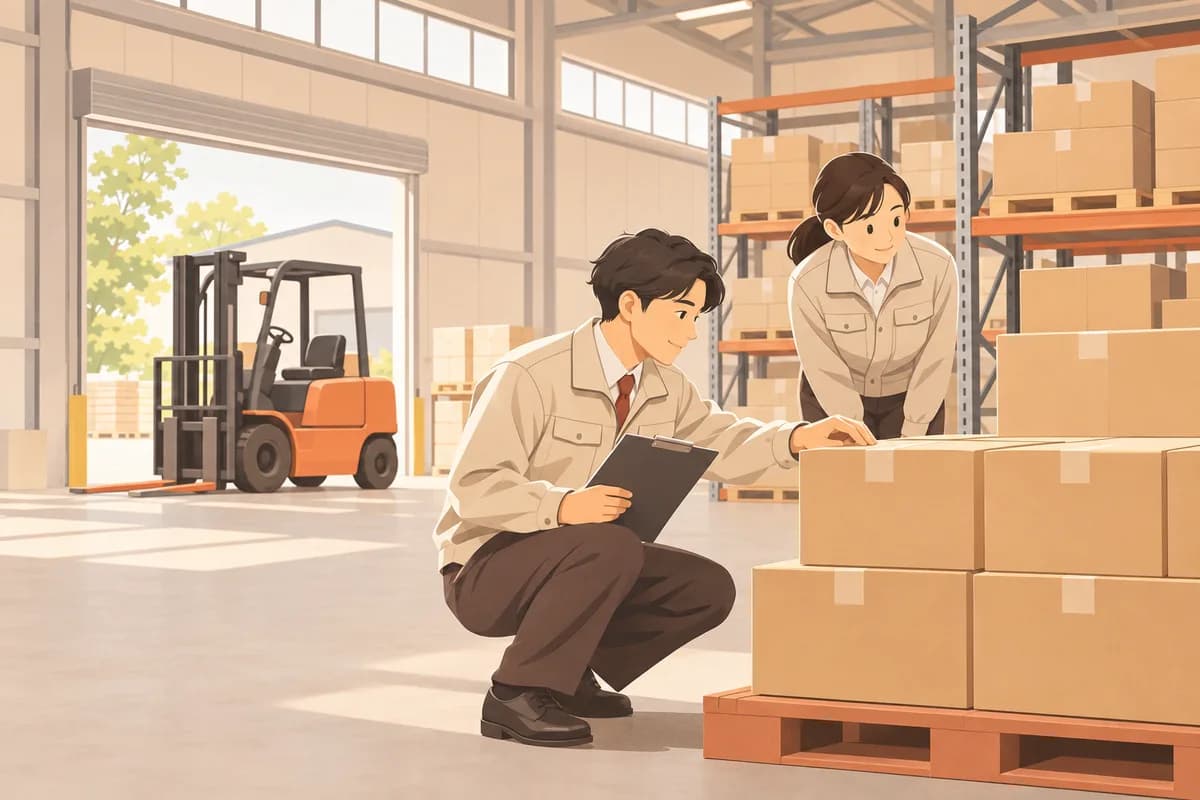
In your first week at a trading company in Osaka, the warehouse calls: 「検品したんですが、段ボールが2箱つぶれています」. You understand every word, but you do not yet know what to say next: ask the quantity, request photos, or report immediately to the shipper in Vietnam. At this stage, one sentence in the wrong order can slow the whole claims process.
Japanese around an import shipment has three layers. With customers and partners you use keigo; with warehouse colleagues it is short and fast; on documents you get dense kanji compounds like 船荷証券, 荷受人, 原産地証明書. Mixed in are katakana loanwords from English, they sound familiar, but the reading and sometimes even the meaning differ.
This article is for people in import/export, freight forwarding, or warehousing who work with Japan, and for those learning to go work there. You get six vocabulary tables following one shipment, five grammar points used constantly, two dialogues with translation and practice tips. The playable word set is at the end of the article.
- Japanese around an import shipment
- Vocabulary by stage of the shipment
- Five grammar points you often hit with customers and partners
- Two dialogues: inspection at the warehouse and calling the customs broker
- How to practice while you work
- Frequently asked questions
- One thing to do right away
Japanese around an import shipment
The same shipment information sounds and reads differently depending on who receives it. The table below shows the four situations you hit most often.
| With whom | Typical style | Example |
|---|---|---|
| Customer, 荷主 (shipper) | Keigo, advance notice and early apology | 船が遅れておりまして、申し訳ございません。 |
| Warehouse colleagues, drivers | Short です・ます, casual short forms | トラック、もう着いた? |
| Email, documents, systems | Compound nouns, few particles, many abbreviations | B/L原本送付済み。通関中。 |
| Shipping line, customs broker | Polite, brief, lots of numbers | カットオフは金曜17時です。 |
The third type leaves many newcomers behind. In the system you see 通関中 (clearing customs), 入庫済み (received into warehouse), 出荷待ち (awaiting shipment): noun plus status only, no full sentence. Learning to read this before you can write it is a sensible path.
On katakana: コンテナ, パレット, フォークリフト, フォワーダー are all borrowed from English, but Japanese read them in their own syllables, so saying "container" the English way will not be understood right away. Abbreviations like B/L, D/O, FOB, CIF are usually read letter by letter in Japanese: ビーエル, ディーオー, エフオービー, シーアイエフ. Hear how a colleague reads them once, then copy.
In the industry you also hear three words not in the playable set but showing up every week: 納期 (のうき, delivery deadline), 納品 (のうひん, delivery to the consignee) and 検品 (けんぴん, inspection on receipt). Many places count 納期 by day, sometimes by hour, so do not change the delivery date without checking first.
Vocabulary by stage of the shipment
The six tables below follow the shipment from parties involved through documents, customs, warehouse, and when something goes wrong. Each table includes kana readings because kanji on documents often read differently from what you guess. The 43 playable words in the game sit in these tables, plus a few extras like 検品, 入庫, 出庫 and HSコード.
Parties involved in the shipment
| Word | Reading | Meaning | Example sentence | Translation |
|---|---|---|---|---|
| 貨物 | かもつ | shipment, cargo | この貨物は横浜港で受け取ります。 | This cargo will be collected at Yokohama port. |
| フォワーダー | フォワーダー | freight forwarder | フォワーダーに船の予約をお願いしました。 | I asked the forwarder to book space on the vessel. |
| 荷主 | にぬし | shipper (cargo owner) | 荷主に出荷日を確認します。 | I will confirm the shipping date with the shipper. |
| 荷受人 | にうけにん | consignee | 荷受人は大阪の販売会社です。 | The consignee is a sales company in Osaka. |
| 運送会社 | うんそうがいしゃ | carrier | 運送会社に集荷をお願いしてください。 | Please ask the carrier to pick up the goods. |
| 輸出業者 | ゆしゅつぎょうしゃ | exporter | 輸出業者から船積書類が届きました。 | Shipping documents arrived from the exporter. |
| 輸入業者 | ゆにゅうぎょうしゃ | importer | 輸入業者の担当の方から連絡がありました。 | Someone in charge at the importer got in touch. |
荷主 is often taken narrowly as "sender." In the industry it means the party that owns the cargo and arranges transport, it may be the seller or the buyer depending on delivery terms. The party listed as sender on the waybill is 荷送人 (におくりにん).
Container, vessel, truck, and loading/unloading
| Word | Reading | Meaning | Example sentence | Translation |
|---|---|---|---|---|
| コンテナ | コンテナ | container | 20フィートのコンテナを1本お願いします。 | One 20-foot container, please. |
| パレット | パレット | pallet | パレットに20箱積んでください。 | Please stack 20 cartons on the pallet. |
| 船舶 | せんぱく | vessel | この船舶は金曜日に出港します。 | This vessel sails on Friday. |
| 港湾 | こうわん | port | 港湾が混雑していて、荷役が遅れています。 | The port is congested so stevedoring is delayed. |
| トラック | トラック | truck | トラックは午前10時に倉庫へ着きます。 | The truck will arrive at the warehouse at 10 a.m. |
| 海上輸送 | かいじょうゆそう | ocean freight | 海上輸送は航空輸送より日数がかかります。 | Ocean freight takes more days than air freight. |
| 航空輸送 | こうくうゆそう | air freight | 急ぎの貨物は航空輸送にします。 | Urgent cargo goes by air. |
| 積み込む | つみこむ | load (cargo) | 午後2時までに貨物を積み込みます。 | We will finish loading by 2 p.m. |
| 荷下ろしする | におろしする | unload | 到着したら、すぐに荷下ろしします。 | When it arrives, we unload right away. |
| 積み替え | つみかえ | transshipment | 釜山で積み替えがあります。 | There is transshipment in Busan. |
People in the industry count containers with 本: 1本 (いっぽん), 2本 (にほん), 3本 (さんぼん). Pallets use パレット or 枚; cartons use 箱. That point is in the grammar section below.
Documents and Incoterms
| Word | Reading | Meaning | Example sentence | Translation |
|---|---|---|---|---|
| 船荷証券 | ふなにしょうけん | bill of lading | 船荷証券の原本は明日送ります。 | I will send the original B/L tomorrow. |
| インボイス | インボイス | commercial invoice | インボイスの金額が契約と違っています。 | The invoice amount does not match the contract. |
| 梱包明細書 | こんぽうめいさいしょ | packing list | 梱包明細書の個数と合っていません。 | The piece count does not match the packing list. |
| 原産地証明書 | げんさんちしょうめいしょ | certificate of origin (C/O) | 原産地証明書があれば、関税が下がる場合があります。 | With a C/O, duty may be reduced in some cases. |
| インコタームズ | インコタームズ | Incoterms | 契約のインコタームズを確認させてください。 | Please let me confirm the Incoterms in the contract. |
| 本船渡し | ほんせんわたし | FOB (free on board) | 本船渡しの場合、船積みまでの費用は売り手が負担します。 | Under FOB, the seller pays costs up to loading on the vessel. |
| 運賃保険料込み | うんちんほけんりょうこみ | CIF (cost, insurance, and freight) | 運賃保険料込みの価格でお見積もりします。 | We will quote on a CIF basis, including freight and insurance. |
In daily talk many people say エフオービー or シーアイエフ straight out, but in Japanese contracts and quotes you still see full terms like 本船渡し. Knowing both keeps you from freezing on any document.
Customs
| Word | Reading | Meaning | Example sentence | Translation |
|---|---|---|---|---|
| 通関 | つうかん | customs clearance | 通関は明日の午前中に終わる見込みです。 | Clearance is expected to finish tomorrow morning. |
| 輸出入申告 | ゆしゅつにゅうしんこく | customs declaration | 輸出入申告は通関業者が行います。 | The customs broker handles the declaration. |
| 輸入関税 | ゆにゅうかんぜい | import duty | 輸入関税は品目によって異なります。 | Import duty varies by product category. |
| 通関業者 | つうかんぎょうしゃ | customs broker | 通関業者に書類を一式送ってください。 | Please send the full document set to the customs broker. |
| 税関検査 | ぜいかんけんさ | customs inspection | 税関検査の対象になったため、貨物が開封されます。 | Because it was selected for inspection, the cargo will be opened. |
| HSコード | エイチエスコード | HS code | HSコードが違うと、関税率も変わります。 | If the HS code differs, the duty rate changes too. |
HSコード is not in the playable word set but you see it daily. The system shares the first six digits globally; each country adds its own digits afterward, so a code declared in Vietnam may be longer than one in Japan. When the broker asks 「HSコードは何番ですか」, they are asking what sets the duty rate.
Warehouse and inspection
| Word | Reading | Meaning | Example sentence | Translation |
|---|---|---|---|---|
| 倉庫 | そうこ | warehouse | 倉庫は午前8時から開いています。 | The warehouse opens from 8 a.m. |
| 在庫 | ざいこ | inventory | 在庫は今30パレットです。 | Inventory is 30 pallets right now. |
| フォークリフト | フォークリフト | forklift | フォークリフトの免許を持っています。 | I have a forklift license. |
| 梱包 | こんぽう | packing, packaging | 割れ物なので、しっかり梱包してください。 | These are fragile, please pack them securely. |
| 検品 | けんぴん | inspection on receipt | 検品は午後1時からです。 | Inspection starts at 1 p.m. |
| 入庫 | にゅうこ | warehouse receipt (inbound) | 今日の午後に入庫して、明日の朝に出庫します。 | We receive into the warehouse this afternoon and ship out tomorrow morning. |
| 出庫 | しゅっこ | warehouse issue (outbound) | 出庫の指示書はもう届いていますか。 | Has the outbound instruction arrived yet? |
| 棚卸し | たなおろし | physical inventory count | 月末に棚卸しがあります。 | There is a stocktake at month-end. |
入庫 and 出庫 are the pair you hear most in the warehouse, they differ by one kanji: 入 is in, 出 is out. When scanning or logging, swapping the two means outbound stock logged as inbound, so learning them as a pair is the surest way to remember.
Quotes, sailing schedules, and incidents
| Word | Reading | Meaning | Example sentence | Translation |
|---|---|---|---|---|
| 運賃 | うんちん | freight charge | 運賃は毎月変わります。 | Freight rates change every month. |
| 見積もり | みつもり | quote, estimate | 見積もりは今日中にお送りします。 | I will send the quote today. |
| 割増料金 | わりましりょうきん | surcharge | 繁忙期は割増料金がかかります。 | Peak season carries a surcharge. |
| リードタイム | リードタイム | lead time | このルートのリードタイムは約10日です。 | Lead time on this route is about 10 days. |
| カットオフ | カットオフ | cut-off (deadline to receive cargo) | カットオフは金曜日の17時です。 | Cut-off is 5 p.m. on Friday. |
| 到着予定 | とうちゃくよてい | ETA | 到着予定は来週の水曜日です。 | ETA is next Wednesday. |
| 遅延 | ちえん | delay | 台風の影響で、船が遅延しています。 | The vessel is delayed due to the typhoon. |
| 破損 | はそん | damage | 箱の一部が破損していました。 | Part of the cartons was damaged. |
| クレーム | クレーム | claim, formal complaint | 破損について、荷主にクレームを入れます。 | I will file a claim with the shipper over the damage. |
| デマレージ | デマレージ | demurrage | 通関が遅れると、デマレージが発生します。 | If clearance is late, demurrage applies. |
クレーム in Japanese is a serious complaint from one party, not casual grumbling like English "claim" might suggest. When you hear 「クレームが入りました」, the first step is to clarify the condition of the goods and record it, not explain the cause yet.
Five grammar points you often hit with customers and partners
1. 予定, 見込み, 可能性: how sure the schedule is
Logistics runs on schedules, and schedules always can change. Japanese has three ways to speak with rising uncertainty: 予定です (fixed plan), 見込みです (grounded forecast), 可能性があります (may happen).
- 到着予定は20日です。
- 通関は明日終わる見込みです。
- 船が遅れる可能性があります。
A common mistake for Vietnamese speakers is using 「と思います」 for everything because of "I think." With customers that sounds like personal opinion, not information from the shipping line. Conversely, avoid 「必ず」 when the schedule still depends on port and weather.
2. 〜いたします and 〜させていただきます: talking about your own actions
When you describe what you will do for a customer, use humble forms: する becomes いたします, 送る becomes お送りします, 連絡する becomes ご連絡します. 〜させていただきます fits when you need the listener’s permission, such as viewing or checking their documents.
- 見積もりを送付いたします。
- 書類を確認させていただきます。
- 後ほどご連絡します。
Two common mistakes: using ご確認します for the other person’s action (correct is ご確認ください), and attaching 〜させていただきます to every sentence so speech feels heavy. For ordinary updates, 〜いたします is enough.
3. 〜ていただけますか: asking customers or partners
Needing a customer to fix documents, send more information, or reply before a deadline, all are requests. With customers use 〜ていただけますか or 〜ていただけますでしょうか; with peers 〜てもらえますか is enough. For a favor to yourself, 〜をお願いできますか is also natural.
- インボイスを修正していただけますか。
- 本日中にご返信いただけますでしょうか。
- 集荷を明日にお願いできますか。
Learners often use 〜てください with customers because the sentence is short and easy to remember. It is grammatically fine but sounds like an order, especially in email. Switching to ていただけますか changes the tone.
4. 〜のため, 〜により, 〜の影響で: stating reasons for delay
When reporting an incident, state the reason briefly and put it first. Noun + のため or により for formal tone; 〜の影響で fits weather or port conditions; 〜で is simpler, for speech.
- 台風のため、出港が延期されました。
- 港の混雑により、荷役が遅れています。
- 書類の不備で、通関が止まっています。
Vietnamese speakers often open with 「なぜなら〜からです」 like an essay “because.” In reports, the reason comes first with ため, then the result. Also distinguish ために for purpose (荷物を届けるために) from ため after a noun for cause.
5. Numbers, dates, and counters
Containers use 本; pallets 枚 or パレット; cartons 箱; cases or shipments 件; weight トン or キロ. Dates have irregular readings: 14日 じゅうよっか, 20日 はつか, 24日 にじゅうよっか.
- 40フィートのコンテナを2本予約しました。
- 段ボール50箱を1パレットに積みます。
- 重さは合計で3トンです。
A common mistake is using 個 for everything and reading 20日 as にじゅうにち. Getting the date wrong is not a harmless pronunciation slip, the customer may misunderstand cut-off or arrival. When you note a date heard on the phone, read it back for confirmation.
Two dialogues: inspection at the warehouse and calling the customs broker
Warehouse staff report dented cartons
Ha works at an import company in Osaka; Tanaka runs the warehouse. They use です・ます because they are same company but not close yet. Read both roles aloud.
| Role | Japanese | Translation |
|---|---|---|
| Tanaka | ハさん、倉庫の田中です。さっき入庫した貨物を検品したんですが、段ボールが2箱つぶれています。 | Ms. Ha, this is Tanaka at the warehouse. I just inspected the cargo we received and two cartons are crushed. |
| Ha | ありがとうございます。中の商品は大丈夫ですか。 | Thank you. Are the products inside okay? |
| Tanaka | 1箱は中身も割れていました。写真を撮って、メールで送りますね。 | One carton had broken contents too. I will take photos and email them. |
| Ha | お願いします。梱包明細書の個数とは合っていますか。 | Please do. Does the piece count match the packing list? |
| Tanaka | 個数は合っています。全部で120箱です。 | The count matches. 120 cartons in total. |
| Ha | わかりました。荷主に連絡して、破損について確認します。パレットはそのまま置いておいてください。 | Understood. I will contact the shipper and confirm about the damage. Please leave the pallet as is. |
| Tanaka | はい、このまま置いておきます。運送会社には連絡しますか。 | Yes, I will leave it. Will you contact the carrier? |
| Ha | はい、クレームの手続きについて、午後に運送会社にも確認します。 | Yes, this afternoon I will also check with the carrier about the claims procedure. |
Calling the customs broker about the C/O
Ha calls Suzuki at the 通関業者 about an import declaration still missing a document. This is the keigo phone style you will use many times.
| Role | Japanese | Translation |
|---|---|---|
| Ha | お世話になっております。輸入申告の件で、お電話しました。 | Thank you for your continued support. I am calling about the import declaration. |
| Suzuki | お世話になっております。インボイスと梱包明細書は拝見しました。ただ、原産地証明書がまだ届いておりません。 | Same here. I have reviewed the invoice and packing list. However, the certificate of origin has not arrived yet. |
| Ha | 申し訳ありません。ベトナムの輸出業者に確認して、今日中にお送りします。 | I am sorry. I will check with the exporter in Vietnam and send it today. |
| Suzuki | お願いします。原産地証明書がないと、関税が下がらない場合があります。 | Please do. Without the certificate of origin, duty may not be reduced. |
| Ha | 関税率は、HSコードで決まるんですよね。 | The duty rate is determined by the HS code, right? |
| Suzuki | はい。今回のHSコードは、インボイスの品名から判断しました。違っていたら、教えていただけますか。 | Yes. This time I determined the HS code from the product names on the invoice. If it is wrong, could you let me know? |
| Ha | 承知しました。確認して、折り返しご連絡いたします。通関はいつ頃になりそうですか。 | Understood. I will check and call you back. When do you expect clearance to finish? |
| Suzuki | 書類が揃えば、翌営業日には終わる見込みです。 | Once documents are complete, we expect it done the next business day. |
| Ha | ありがとうございます。よろしくお願いいたします。 | Thank you. I appreciate your help. |
How to practice while you work
Start by playing the word set in Falling Stars or Pop It. Play until you see kanji and can say the meaning, then return to the tables above and read each example sentence aloud.
Next step is listening. Pick one episode from the Japanese podcast, listen sentence by sentence and transcribe, then compare with the original. Calls with Japan are often fast and drop subjects, so transcribing line by line shows where your ear skips, especially sentence endings and particles. For a structured path, see courses, and use the vocabulary test to see where you stand.
Outside WELE: Japan Customs publishes English pages explaining import/export procedures, good for cross-checking terms against Japanese. The online dictionary Eijiro (英辞郎) is fast for industry English–Japanese terms. For foundations, Japan Foundation’s Marugoto course has a free edition. JLPT level required varies by company and can change, so read job postings; when you want to try your level, JLPT mock tests on WELE show where you are.
People in forwarding often answer email between calls, so a fixed one-hour study block is hard to keep. Short regular sessions usually stick better than one long weekend block. If your work is closer to purchasing or production, see also Japanese for manufacturing plants and Japanese for purchasing, or browse all of Japanese by profession and the logistics page.
Frequently asked questions
What Japanese level do you need for import/export at a Japanese company?
It depends on role and company, there is no single standard. Document staff need solid reading; customer-facing roles need stronger listening and speaking. Check specific job posts and ask recruiters directly what they apply.
What is 貿易事務, and how is it different from 物流?
貿易事務 handles paperwork for international trade, contracts, documents, liaison with forwarders and customs, usually office-based. 物流 is broader: transport, warehousing, and cargo coordination. Many companies split the roles, so read job descriptions carefully.
For industry katakana, can you just speak English and be understood?
Not always. Japanese read コンテナ, フォワーダー, パレット in their own sounds, and words like クレーム carry a different meaning from English. Learn spelling and reading, and watch actual meaning in the field.
How should email to Japanese partners open and close?
Open with 「お世話になっております」, state the business directly, close with 「よろしくお願いいたします」. If there is an incident, put apology such as 「ご迷惑をおかけして申し訳ございません」 early in the email, not only at the end.
Do you need kanji to read documents?
Yes, at least the ones that repeat, like 船, 荷, 通, 関, 輸, 入, 出. A few dozen of these let you read most headings on B/L, インボイス and 梱包明細書, then look up what is new.
One thing to do right away
Play one round of the word set in Falling Stars, then pick three sentences from the tables above and read them aloud before your next call with the warehouse or customs broker.
